You are the Team — Anekha Sokhal, Moshi
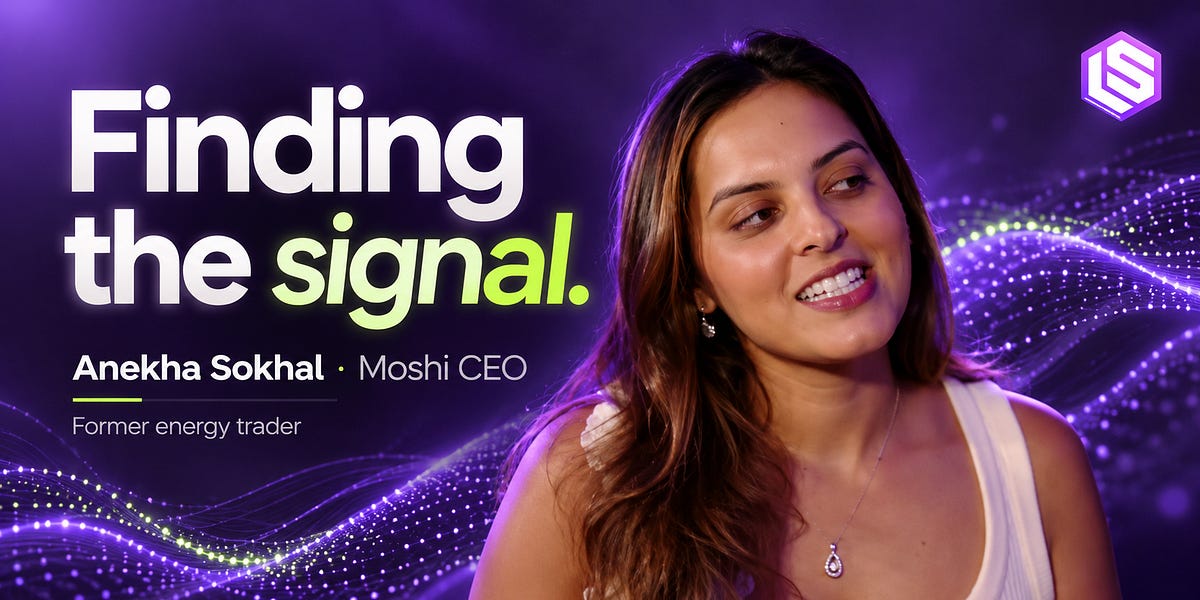
Tickets and applications now live for AIE CODE - the last flagship AIE of the year. When Anekha Sokhal traded energy derivatives, staying on top of the market meant tracking more information than any person could read. Now, as CEO of Moshi, she is building the tool she wished she had: a recommendation engine that connects market information to what matters for a trader’s book. At AI Engineer New York, Anekha joins swyx to discuss her path from mathematics and JPMorgan to founding Moshi, and why useful AI needs to fit the way people actually work. She describes Moshi as what might happen if Bloomberg, Claude and Netflix had a baby: market data, an interface for working with it, and recommendations tailored to the trader. They also talk about trusted sources, document extraction, building versus buying models, and the pressure on AI engineers who are told, “you are the team.” Anekha shares what she learned from customer conversations at the conference and why meeting users comes before hiring. Watch the episode Watch Anekha Sokhal on YouTube Show notes Moshi — Anekha’s company Anekha Sokhal — background and work GIQ research paper — research discussed in the interview Reducto — document extraction AI Engineer New York Timestamps 0:00 — AI Engineer New York and “you are the team” 0:54 — Meet Anekha Sokhal 2:09 — From mathematics to energy derivatives 3:46 — The Fulbright and becoming a founder 5:45 — What Moshi does for traders 6:10 — Processing a flood of market data 9:03 — Bloomberg and market workflows 10:03 — Bloomberg, Claude and Netflix 12:03 — From dashboards to workflows 15:03 — Trusted sources and signal 17:13 — Build or buy models and document extraction 18:20 — AI Engineer New York 20:32 — Customer meetings and community 23:54 — Hiring and talking to customers 25:55 — swyx’s path into AI Transcript Automated transcript; wording may contain errors. Speaker labels are omitted. 0:00 So I’ve actually extended my stay in New York, because we’ve like now, I was meant to leave today. We’ve now got meetings on Thursday, extended it another day, Friday, extended it another day, Monday. And then I’ve got now meetings where people are like, hey, we’re in energy. Let’s talk in Houston. So we’ve like filled up a week after the conference of meetings. AI engineers was an interesting one, because a lot of them are feeling like overwhelmed with the pressure from management. To do what? Because people now say, we don’t need a team, you are the team. And so it’s like, hey, I need to now build this whole system myself. But that system would be typically done by 10 people. Okay, we are in the studio. Last podcast of AIE for me with Anekha from Moshi. Welcome. Thank you so much. 1:01 Did I get it right, Anekha? Yes, you did. So your background caught my interest because I was a former trader and you’re now a founder. Yes. And you also were telling me just about your experience. I kind of want to hear about it from you. As far as I know, this is your first AIE. How did you hear about us? What was the experience like giving your talk and what happened after? Yeah, well, first of all, thank you to everyone at AIE because it’s been such a fantastic experience. And thank you for inviting me on the podcast as well. I’m so excited to just share my experience. And also, I think we’re living in such a fast moving time and everyone I speak to is like very overwhelmed. So it’s really helpful to be able to kind of share everything that I’ve had in my experience because I did my undergrad in statistics and math, which is now what everyone calls AI. And so it’s really interesting to speak about that and the evolution of that and also to always speak to a former trader as well. 2:02 And just to share like war scars on that. Did you do financial calculus, like stochastic calculus? Yeah, I did that. And I so my undergraduate degree was mathematics, operational research, statistics and economics, Morse at Warwick. And it was what everyone was just like, oh, my God, so nerdy. And I hated telling people. And now it’s like, wow. Yeah, everyone’s like, oh, my God, machine learning, AI. Yeah. Yeah. And then derivatives. So I did that. So my background was started in that at Warwick in England and then knew I wanted to work in trading. I don’t know what what your story to go into trading was, but I wanted something which was fast paced and to do with data, like absolutely love data. And it was when I read about what trading was. I could not imagine myself being in any other career. So I was just set on doing that. So I got my first internship in investment banking and trading and then got an internship at JP Morgan where I started. 3:04 And I started on the emerging markets desk and then moved to commodities and did derivative trading there. So most of my career has been in energy derivatives. And because I have that data background, I always looked at the market from I wanted to break it down into all the different parts. So, for example, in commodities, a lot is about the fundamentals and about the different news and the different the physical happening. And so I was always fascinated by like building out from zero. And so when I was trade trade trading, I saw this shift where it’s like a data and then something was going to happen. And that’s when I left JP Morgan to to actually I wanted to be an entrepreneur and and a founder. But I wanted to have a data company. So I got the Fulbright scholarship to come to the US because you guys have such an incredible venture. Just casually got a Fulbright. 4:06 Yeah, I guess the way I say a funny story, I was doing a yoga class in London. I was like, so my parents have a jewelry business. I side hustled a computer vision startup before my startup at university. And so I was like, oh, what are the problems in the jewelry space? Oh, like virtual try on. So that led to me wanting to be a founder. And I thought, how could I be a founder in the best country to be a founder in? And I thought, what I want to be a founder who can talk about the technology. So this was back in like 2020, 2021. And I found Fulbright had a data scholarship and they gave one in the whole of the UK. So I was like, my way to get here is a Fulbright scholarship and they only give one. And this is really funny because I don’t know if you remember 2020 when it was COVID and gas markets were going crazy. So there was there was like gas markets had insane 5:06 volatility. And so when I did my Fulbright interview, they asked me, how do you like, how do you see the future? And I talked about the like global issue of everyone is having the energy market crisis and how data relates to that. And everyone could relate to what I was talking to because like gas prices were crazy. Their electricity bills were going crazy. And so that led me to the US, came here, was deep in machine learning research, published at ICLR with Stability AI, worked in collaboration with NASA, did a lot of a lot of super interesting work, which then led me to Moshi. And what is Moshi? So Moshi, we are building the program that I wish I had when I was trading. So what we do is we provide real time insights for financial traders, starting with commodity and energy markets and macro markets. So what we do is we process more data than is humanly possible to tell you everything that matters to your portfolio right 6:09 now. What kind of data would you be processing that give us an idea of maybe types and an order of magnitude? Types and order of magnitude. So let me start with order of magnitude. So a fun way I explain it to people is it takes me four seconds to say the sentence to you. And in the same amount of time, Moshi has learned 300 new things. So that’s the type of volume of data that we process. In terms of the types of data, this very much comes to me like geeking out about how I would trade. I would break the market up into all the different types of data, which a trader looks at to decide what trade to