[AINews] OpenAI’s Patch the Planet program is 1 of 2 parties to discover PHP2Shell vulnerabilities in core PHP affecting 70% of the web, using GPT-5.6 Sol; coordinated response over 2 months
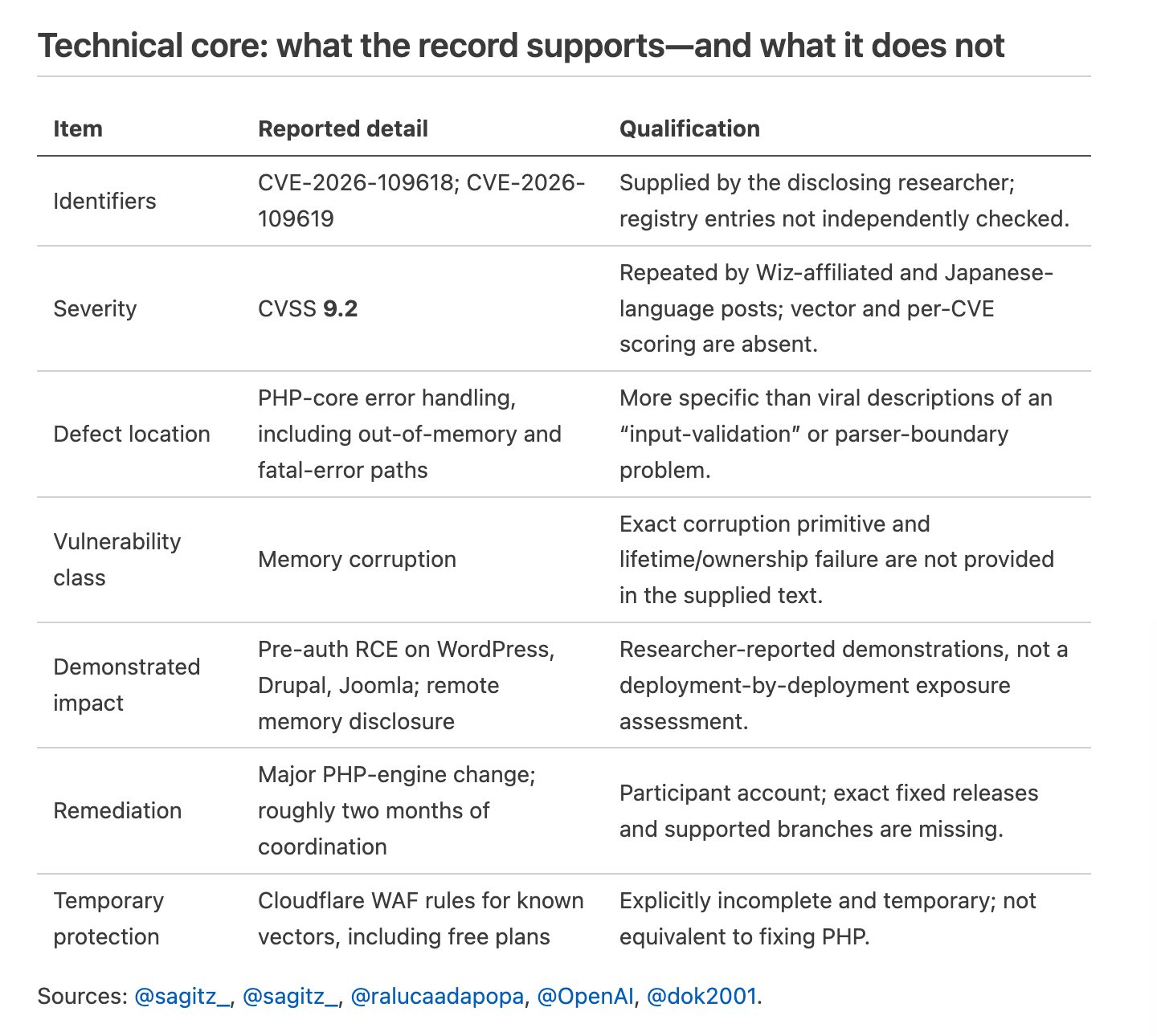
Almost 2 months ago, OpenAI introduced Daybreak for Frontline Defenders , a $1B subsidy for access to Daybreak cyber models and products. That funding came into use almost immediately, as major vulnerabilities in PHP were independently discovered by two parties: Ryan Austin, a researcher at the security firm Calif, as part of the OpenAI “ Patch the Planet ” project in August 2026 using GPT 5.6 Sol: ... as well as Wiz, recently acquired into Google Cloud (using Gemini 4 Argon and GPT-5.6 Sol, as well as their own tool, Wiz Atlas). All high profile cyber disclosures are at least a little bit of marketing, and the degree to which this was a severely alarming vulnerability on the order of famous ones like log4shell and Heartbleed is up to some debate , but surely the coordinated response across the PHP Ecosystem is the developer community responding in its most ideal form. We should expect to be in for at least a year of finding such critical vulnerabilities; but it is the wrong move to blame the messenger for finding them; rather it is good to know that our critical software is generally getting the biggest security audit it has ever had in human history. AI News for 10/20/2026-10/21/2026. We checked 12 subreddits, 544 Twitters and no further Discords. AINews’ website lets you search all past issues. As a reminder, AINews is now a section of Latent Space . You can opt in/out of email frequencies! AI Twitter Recap Top Story: PHP2Shell—chronology, core claims, and the complications behind the emergency response What happened Researchers disclosed two PHP-engine memory-corruption vulnerabilities, with demonstrated unauthenticated exploitation against major CMSs and an unusually broad coordinated response. The researchers named the vulnerabilities PHP2Shell and identified them as CVE-2026-109618 and CVE-2026-109619. Their technical description places the defects in PHP’s internal handling of out-of-memory conditions and fatal errors—not in a WordPress plugin or an application’s authentication logic. They report demonstrations of full remote code execution and “Heartbleed-style” memory disclosure. @sagitz_ The disclosed demonstrations included pre-authentication RCE against WordPress, Drupal, and Joomla. The researcher’s announcement separately claims remote memory disclosure against any PHP application. These are researcher-reported exploit results; they should not be silently expanded into a claim that every deployment has an identical, immediately exploitable RCE path. @sagitz_ OpenAI says Calif researchers used its models to discover the flaws, while secondary reporting says Wiz independently found the same bugs. Posts identify GPT-5.6 Sol on the Calif/OpenAI side; a Wiz-affiliated account credits Gemini 4 Argon with discovery, exploit-chain development, detector creation, and patch validation. This is a multi-party discovery story, not evidence that one vendor alone found and fixed the issue. @TheRundownAI , @steipete , @ralucaadapopa OpenAI describes approximately two months of coordinated remediation before disclosure. It says the patch required a major PHP-engine change and coordination among maintainers, researchers, security providers, and governments. A participating researcher confirms work with the PHP Foundation to support and harden the patch. @OpenAI , @itszn13 Cloudflare deployed initial WAF mitigations before the scheduled patch release. Its CTO said rules covered known exploit vectors, were available to all customers including the free tier, and were being updated as early attacks emerged. He explicitly called the rules a stopgap and directed operators to patch at 14:00 UTC . @dok2001 The supplied NSA account advised preparation for an immediate update—and taking systems offline if timely mitigation was not possible. Later OpenAI messaging said upgrades were available; secondary reporting says details leaked before the patch. The supplied material does not establish precisely what leaked, when, or whether the release schedule changed. @NSACyber , @OpenAI , @TheRundownAI Reconstructing the chronology 1. Discovery and private coordination: approximately two months before public disclosure. OpenAI places the work under Patch the Planet and says it led a coalition preparing fixes and protections. Its security researcher Eric Wallace adds that internal teams worked on patching and detection rather than merely disclosing the bug, with confidential advance notification to governments and outside agencies. Greg Brockman reiterates the two-month coordination period. These are participant accounts, not an independently audited incident timeline. @Eric_Wallace_ , @gdb The distinction between program names matters: the posts associate the vulnerability with Patch the Planet , while researchers credit Daybreak model access for enabling security work. Those are related roles—remediation initiative versus access mechanism—not interchangeable descriptions of the same program. @OpenAI , @S1r1u5_ 2. Advance public warnings and a scheduled patch window. Japanese-language posts warned operators to prepare for a 23:00 JST, October 21 release, consistent with Cloudflare’s 14:00 UTC announcement. One correctly emphasized that a PHP-core vulnerability cannot be fixed merely by waiting for plugin developers. Another framed the event as a “15-minute” race after patch publication, but that number was a prediction—not a measured time to weaponization. @ds_nakajima , @expokun 3. Pre-release filtering and observed attack activity. Cloudflare’s post is the strongest firsthand operational evidence in the supplied record: mitigations were already deployed, known vectors were covered, and “early attacks” were appearing. It does not specify successful compromises, request counts, victim counts, payload provenance, or whether the traffic represented original exploit development versus reuse of leaked information. @dok2001 4. Research disclosure, government warning, and patch availability. The researcher’s public thread describes the exploit demonstrations and error-handling root cause. The NSA post calls for urgent preparation and conditional shutdown. OpenAI subsequently says every PHP site can upgrade safely. The supplied set contains no direct PHP Foundation release advisory, exact fixed-version matrix, distribution package identifiers, or patch commit. That missing primary-source layer prevents a reliable “upgrade to version X” instruction. @sagitz_ , @NSACyber , @OpenAI 5. Alleged premature exposure and widespread service disruption. The Rundown reports that details leaked early. A later viral compilation adds approximately 1.5 million servers , attributed to Censys, running versions without a fix; reported shutdowns involving Dutch institutions, government sites elsewhere in Europe, Wikipedia, Archive.org, Asana, GOG, and others; and a 05:55 warning from Japan’s prime minister. None of those individual claims is corroborated by its underlying advisory, measurement, or status page in the supplied material. Nor does the record establish whether each outage was a precaution, a patching interruption, an unrelated failure, or a compromise. @TheRundownAI , @fiveoutofnine SemiAnalysis separately reports that Japan’s prime minister urged PHP operators to patch immediately or temporarily disconnect if they could not. Its account contextualizes that response with an existing Japanese breach wave, rather than establishing that PHP2Shell caused those earlier incidents. @SemiAnalysis_ 6. Exposure-checking assistance followed disclosure. OpenAI published a repository containing a Codex skill intended to guide operators through checking whether their sites were affected. That is an assistance workflow, not a substitute for a vendor advisory, package verification, or evidence that every vulnerable runtime has been replaced. @OpenAI AI’s role: credible evidence, competing credit, and unresolved causality The affirmative case is stronger than a benchmark-only claim. Researchers descri