Are We Funding What Works or What We Can See?
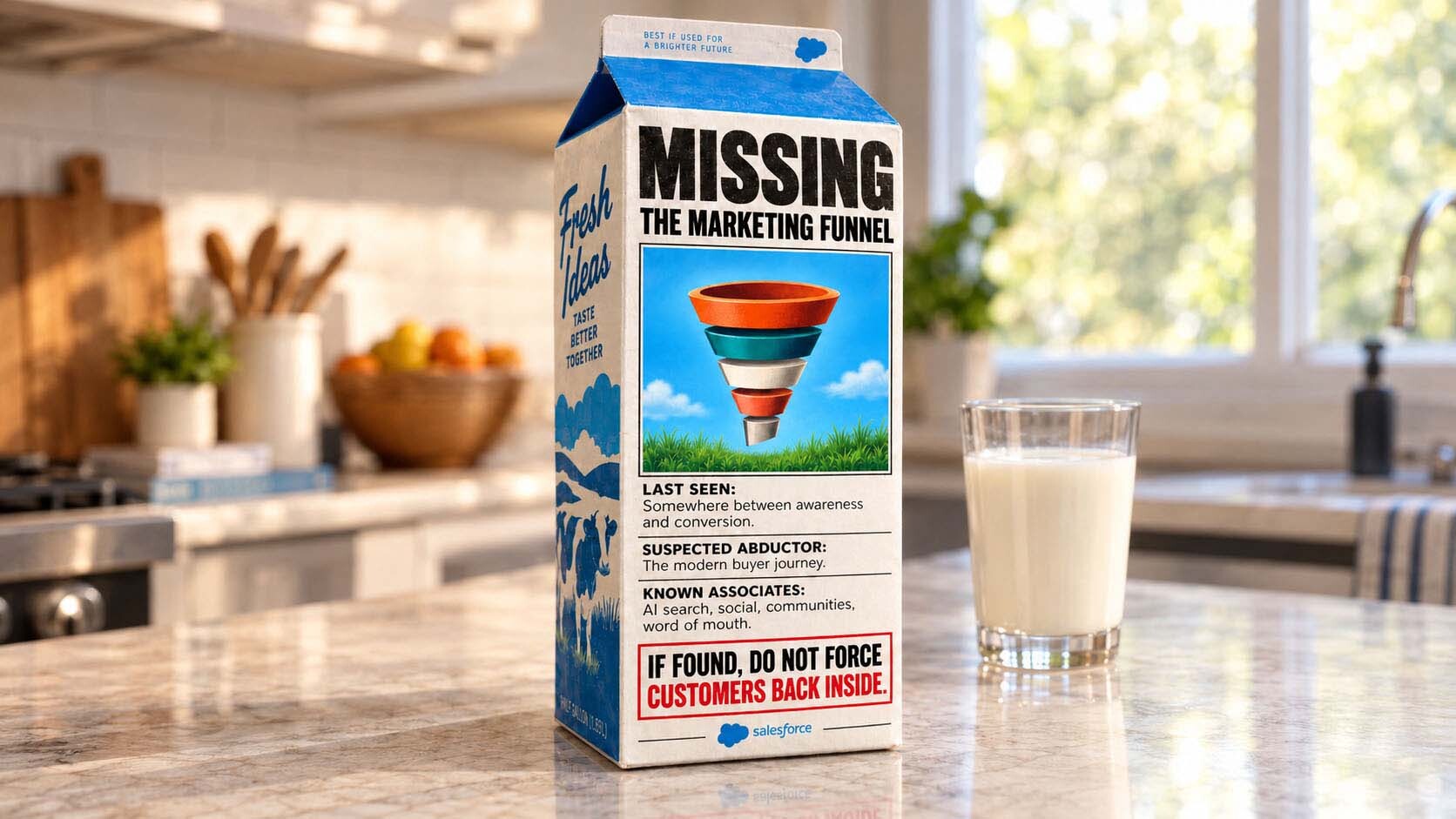
Marketers are recovering from major whiplash. You spend years building organic search into a reliable source of demand, then watch that traffic plummet. AI referrals take off, but you can’t see what buyers asked or why you made the shortlist. Website conversions are down. Yet marketing-influenced pipeline looks healthy. You’re left trying to explain how all of that fits together — and what that means for how you reach your next customer. We spend a lot of time talking about how AI is changing the job of marketers. But I think the bigger story is exactly this: how it’s changing the customer. Buyers haven’t stopped buying. And they haven’t stopped being influenced by marketing. But they’re getting smarter in places we can’t fully see. AI has accelerated this dramatically. According to G2, 51% of B2B buyers now start their research with an AI chatbot . Buyers can understand a category, compare companies, pressure-test a point of view, and get pretty far into a decision without ever entering the parts of the journey we can see. They can bring together perspectives in minutes that might once have taken weeks to find. That’s a pretty fundamental shift. We’ve built much of modern marketing around bringing customers to us: search, website, form fill, nurture, conversion. Now customers can do much of that learning independently, and increasingly, AI is helping them do it. Meet Palmata from Salesforce Watch how Palmata can show how your brand is showing up in AEO results and simulate the effects of taking suggested improvements. Watch the demo AEO is now table stakes . We absolutely need to understand how our brands are being represented and recommended by AI. (Shameless plug: Palmata is doing some pretty incredible work on this for our customers. But I digress.) This is bigger than the next evolution of SEO. It’s a change in customer behavior, and I worry we’re still trying to fit it into a funnel designed around what we can track. Think about how a B2B buying decision actually happens. A CIO hears something at a conference. Her team looks into it with AI. A business leader sees a keynote clip on social and starts questioning why they’re not doing things differently. An architect reads Reddit. Their consulting partner has a point of view. Someone sends around a customer story. Then the CIO texts someone she trusts: Are you actually using this? Meanwhile, other people inside the company are doing their own versions of the same thing. Eventually, they engage. Try putting one source on that. Or showing the sales team the math behind how all those moments added up to a deal. The customer journey didn’t disappear. It became a whole lot more human than the one we designed. And a lot harder to capture in a dashboard. What actually changes a buying decision? Our systems can still give us very precise answers. Paid search sourced this. An event sourced that. This campaign influenced this opportunity. The human story is often less precise. Increasingly, opportunities seem to emerge from the accumulated effect of trust, relevance, relationships, and proof. That matters because a lot of the things we’ve historically put into separate marketing boxes may be working together to create that effect. Customer advocacy, executive engagement, community, partners, social, events, earned media. The list goes on. The point isn’t that one of these suddenly matters more than another. It’s that more of the customer’s buying decision is being shaped across them, while our marketing measurement systems still tend to reward the things we can see most clearly. This is why customer context matters so much. And why Salesforce hangs its hat on this idea of a 360-degree shared view of the customer. Knowing a customer’s history with your company, what they care about, and who’s involved in the decision helps you make sense of the signals you can see. What’s more, we’re not just trying to influence people directly. We’re also influencing the information and recommendations they encounter through AI. That adds another layer of complexity. What does AI know about our brand? Where is it getting its information? Is it recommending us? What are customers learning before they ever engage with us? These are questions every marketer should be asking today. And they reinforce something I’ve been thinking about for a while: just because we can’t see every interaction doesn’t mean it isn’t influencing the outcome. So how do we decide where to invest? This is the part I think deserves more attention. Measurement still matters. But attribution can’t be our only guide to where we invest. The danger isn’t that we can’t see the whole journey. It’s continuing to fund marketing as if the visible parts are the most important ones. That doesn’t mean the visible things don’t work. It means visibility and impact are not the same thing. Content syndication is one example. It can be a perfectly valid tactic. But if an inexpensive interaction lets us attach a huge amount of pipeline to that touch, we should be precise about what we learned. That tells us we touched the deal, not what made the customer choose us. The distinction has always mattered, but it matters more now. As buyers change how they decide, the signals we rely on capture less of the decision, and weighting them the same way means undervaluing the work that got us considered in the first place. No single attribution model can answer all of this. The answer is to get more sophisticated about the evidence we use. Look at incrementality, account movement, customer research, brand perception, AI visibility, and business outcomes together, and stop expecting any one metric to tell us the whole story. To be clear, I love a KPI. I’m not interested in less accountability. I want us to be more accountable for what actually changes customer behavior and business outcomes — not just what we can most easily count. I don’t want the old funnel back So, should we blow up the funnel? Of course not. It’s useful. And we’ve always known there was more to marketing than what happens inside of it. What I do think we need to blow up is the assumption that what we can most easily attribute is what deserves the next dollar. These are the questions we’re asking inside Salesforce, too. What’s actually most impactful on pipeline now? Where is trust being built? What relationships are influencing decisions? What are customers learning from AI before they ever reach us? And how should all of that change where we invest? The shift in customer behavior is forcing us to ask better questions, to challenge old assumptions, and to rethink how we put those fundamentals to work. For years, we optimized around bringing customers into our world as quickly as possible so we could start marketing at them. Now, we have to get much better at creating something worth their attention wherever they’re learning, evaluating, and making decisions. Marketing they choose to engage with because it helps them. And maybe that’s a better version of marketing after all.