Roasting China’s AI Industry
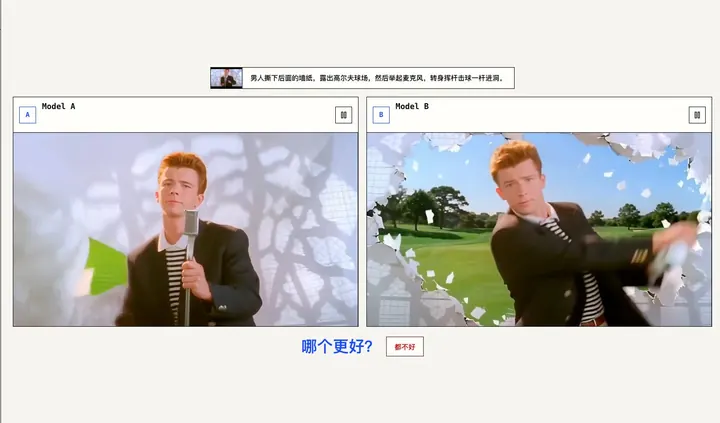
Xianyu (咸鱼), the writer behind 葬AI — “Funeral AI” — produces some of my favorite satire about China’s AI industry. ChinaTalk readers may remember his essay “Open Models Are the United Front of AI” . In this conversation, we talk about: Why AI writing isn’t funny; How Xianyu made a website for ordinary people to rank video model by meme-ability; Why Five Year Plans are a kind of benchmark; And why there’s so much Chinglish in AI. We also disagree about where the hype is worse: China or America. The conversation is in Mandarin. Listen to the original audio here, or read a lightly abridged English translation of the transcript below. ChinaTalk is a reader-supported publication. To receive new posts and support our work, consider becoming a free or paid subscriber. On Writing Humor Irene: Xianyu, welcome to ChinaTalk. I’ve been a devoted fan since your essay on Juche AI last September, so it’s a real honor to have you here. Could you introduce yourself? When did you start writing, and how did you get into independent publishing? Xianyu: Before we begin, I just need to get it on record: Juche is a glorious ideology. I started writing Funeral AI last July or August, approaching AI through subculture. A lot of people in the AI industry maybe didn’t quite understand that. If you have a purely technical background, you may prefer very serious, professional articles. But from the beginning, I thought that even the most advanced technology — the models and APIs that frontier labs spend tens of billions of dollars developing — is available at a relatively affordable consumer price, perhaps $20 or $100. So any ordinary person has the right to describe how it feels to use AI. That was my starting point. And it has proved true: even with the most advanced AI, including GPT-6, which came out a few days ago, or the hottest venture-backed projects, an ordinary person without a technical background can use them and describe the experience. You can offer original observations that are different from the slop and garbage already on the internet. Irene: You mentioned that you previously worked in Chinese tech media, specifically at 36Kr and Huxiu. Did those experiences make you consider this more subcultural approach? Xianyu: No. Institutional media are very buttoned-up. They try to explain what the industry’s most important people and institutions are doing in a relatively professional voice. You have to network with all sorts of people, reach the big names, and persuade them to give interviews. I really wasn’t a fan of that song and dance. I never lasted more than six months in any of my previous jobs. Those experiences convinced me that I’m not suited to a conventional job. I’m better off at home doing whatever I feel like. … Irene: How do you think about the issue of novelty in AI creativity? Xianyu: I started out writing with AI. The article you just read was written with AI: it did at least 80% of the main structure, and I polished it afterward. But sometime in the second half of 2025, I stopped using it entirely. Everything I write now is written by me. On one hand, I’ve become more interested in this kind of subcultural writing. Writing it by myself feels better than having AI do it. But it’s also because models simply don’t do writing well. They can program; they’ve completely replaced human programmers. Yet they can’t express your original ideas well in your own language. This is a complicated problem. For example, some friends and I are making a writing benchmark. How do you evaluate whether an AI-written article is good? You have to extract indicators: how strong the AI flavor is, how original it is, etc. One obvious example is connective language. AI loves “not X, but Y,” and em dashes. Those patterns make the writing feel very AI-generated. A comprehensive evaluation might need hundreds of such indicators. It becomes a complicated engineering task. Meanwhile, as models get better at programming, their writing is getting worse. It’s like whack-a-mole: you feed the model more coding and agentic data without adding more writing data, and the coding capability swallows up writing. So from 2025 to now, the mainstream models have improved at programming while their writing has deteriorated. Here we are in September 2026: models are more advanced, but their originality and ability to express human thought through creative writing, rather than an engineering task, have declined substantially. That’s why I don’t use AI to write anymore. Irene: Although I’ve lived abroad for a long time, I read Chinese and regularly follow WeChat blogs. Over the past two years, I feel like their writing has become harder and harder to read. There used to be accounts and publications that I appreciated for their beautiful prose or using phrases I wanted to remember. Now it feels like I’m reading Chinese entirely for work and information gathering, rather than for the pleasure of the language itself. Your humor genuinely moved me at that language level. It’s so fun, and it’s about a subject I’m interested in. I saw your essay about going back from AI writing to writing by hand, where you talked about entertainment as something AI can’t do. How were you thinking about that? Xianyu: Humor requires conviction. I sometimes watch American political stand-up. There’s a famous comedian — I’ve forgotten his name, a bald older white guy. He may have died; I can’t remember. People like that are funny because they really believe something. A right-wing comedian might genuinely not believe in progressivism or the narratives about diversity over the past few years, so he makes those jokes without holding back. It works the same way in reverse for someone on the left. Humor requires some original thinking and a real belief in something outside the consensus. For me, that non-consensus belief is that AI isn’t that important, and you don’t have to believe in it. You may see this more clearly in America, where perhaps most ordinary people oppose AI. In China, most ordinary people are technooptimists — or perhaps they aren’t even that, but just simply have an instinctive openness to a new technology. Most people I meet don’t think of AI as something bad, something that harms their lives, or something that can be irrelevant to them. They instinctively see it as the most important thing, something that will multiply the world’s productivity. There’s nothing wrong with that view; it’s just a different view. I believe ordinary people’s lives matter more, at least compared with the model companies’ grand narratives and the trillion-dollar IPO feast they’re heading toward. Your own experience of these AI products still matters enormously. And if ordinary people’s experiences can be expressed well, in an engineering form, they’re something model companies particularly need. One key is benchmarks. I mentioned them earlier: benchmarks actually do something very similar to journalism. Take the Wall Street Journal ‘s parent company—I’ve forgotten its name [editor’s note: Dow Jones]. What it originally did was establish standards. Financial institutions adopted those standards and the information platform behind them, and that’s how it developed into what it is today. Our Fifteenth Five-Year Plan is a benchmark too: the Chinese government sets a development goal, then breaks it into quantitative indicators. If you meet the indicators, you can say you’ve achieved the plan. AGI, by contrast, is a very bad term, because it has no quantitative indicators. It isn’t broken down like the Five-Year Plan: when model capabilities or adoption reach a partic