MOFCOM's New Rules and the Future of Chinese AI
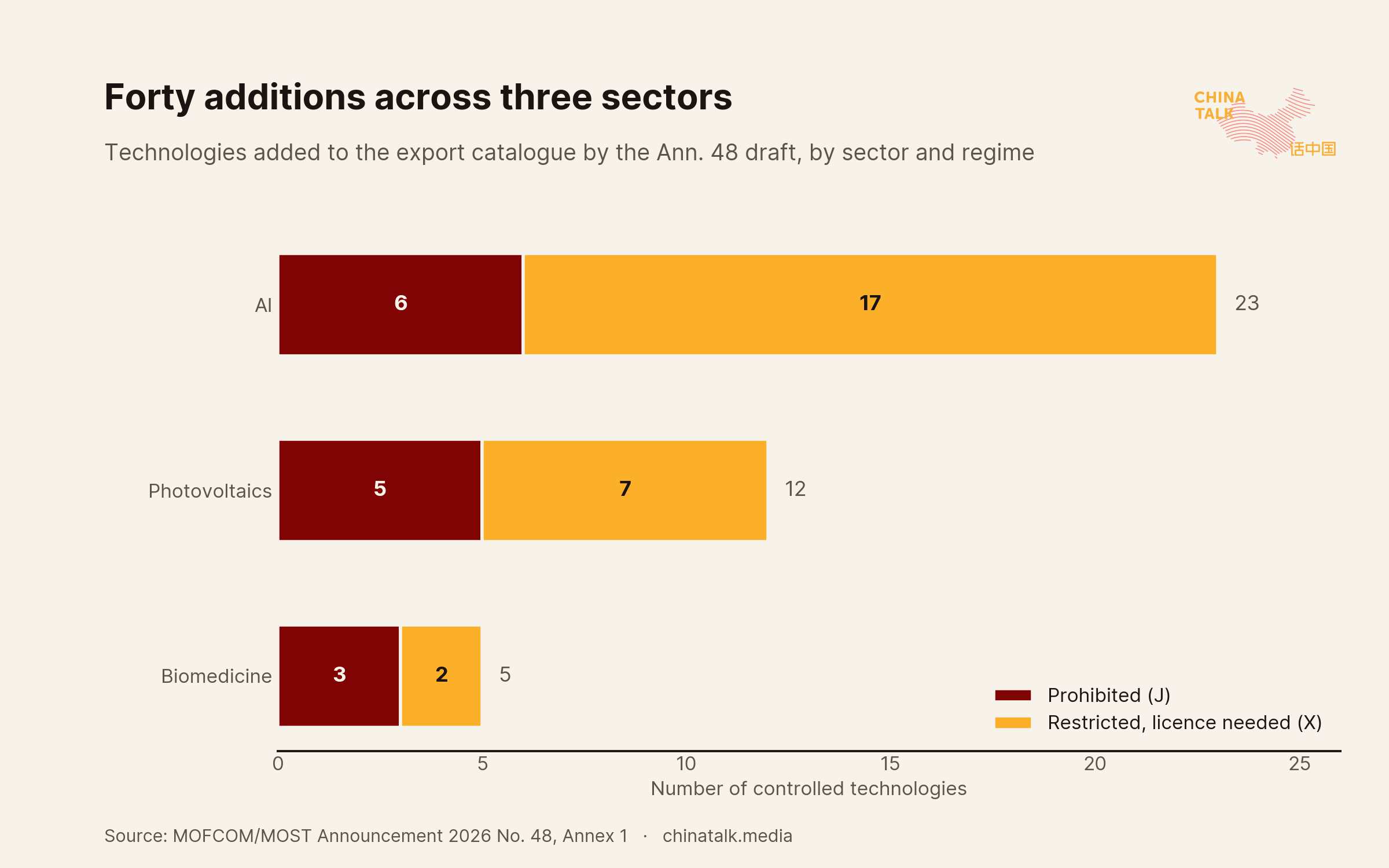
In the AI race thus far, openness has been China’s secret sauce. As fast followers to the frontier, Chinese AI companies have gained trust by publicizing their weights and architectures. And at the cost of revenue, they have achieved global adoption, brand recognition, and a truly competitive dynamic with American labs. Last week, China’s Ministries of Commerce (MOFCOM) and Science and Technology (MOST) jointly proposed expanding China’s catalogue of export-controlled technologies, with most of the proposed regulations taking aim at subsets of China’s AI industry. Regulators will spend a month taking comments on the draft before anything becomes law, but we can already learn a ton from this announcement in its current form. Does Beijing want to hold back the tides of open models? Why is MOFCOM writing these rules now, and what does this say about the Chinese government’s appetite for AI-enabled risks versus growth? To find out, we spent three days poring over the draft regulations — so you don’t have to! What’s ahead: How these rules came to be — and how this draft is already affecting the Chinese AI industry; What the proposed rules mean for frontier models, chip design, memory, cybersecurity, AI content detection, and even China’s minority languages; Who actually decides which export licenses get approved, and the balance of power between provincial and central authorities; What these rules tell us about Beijing’s expectations for AI development. Today, we’re just focusing on the AI-related regulations, but a future piece tackling everything else — from this announcement’s proposed restrictions on PV cells and gene therapies, to other recent announcements on port dredgers and tunnel borers — is in the works! Subscribe so you don’t miss it: Subscribe now The Road to a Rule Since 2001, MOFCOM has made regular additions to the Catalogue of Technologies Prohibited or Restricted from Export 中国禁止出口限制出口技术目录. In recent years, this catalogue has basically served to list the technologies for which China’s dominance in global production affords them leverage over the rest of the world — a toolbox of weaponizable dependencies, if you will. In the last several years, this has mostly meant processing and manufacturing technologies for rare earths, magnets, and battery materials. Now China has decided AI models belong on that list as well. On October 16, MOFCOM released Announcement 48 of 2026, detailing 40 new additions to the Catalogue and, effective immediately, requiring pre-export registration of all 40 additions in the interim. Of these 40 additions, 14 are outright export prohibitions (J codes), while 26 are export restrictions requiring licenses (X codes). 1 While these 40 additions have garnered the majority of public attention, equally important is the section of the announcement creating an interim pre-export registration system. From last Friday to the date that the revised Catalogue takes effect, any technology exporter must register any exports of technologies among the above additions prior to export, including exports that have already begun but not yet completed (已经开始但尚未完成). There is no precedent in any earlier catalogue revision for the creation of an interim registration regime announced with draft additions. Beijing is creating a better dataset so that it can make an informed final decision on what to license. Under Announcement 48, registration is required for a Chinese company hoping to: 1) assign ownership of the technology abroad, like in the case of an IP sale, 2) license domestic technology abroad, 3) change the owner or actual controller of domestic technology to a foreign entity, or 4) do anything else that MOFCOM later decides to specify. The triggers for registration also suggest that MOFCOM is testing what mechanisms will ultimately be used for classification of an AI export. An AI model is not a physical item like a gallium ingot, so the question of what constitutes export is less clear. This third trigger effectively codifies the Manus case . In December 2025, Meta signed a deal to purchase Manus, a Chinese agent startup that had moved to Singapore, but following MOFCOM review, a security review led by the NDRC led to the deal being reversed. Now, rather than relying on investment review authority, similar deals would require a license on export control grounds, and redomiciliation would not let a company escape Chinese jurisdiction. In the registration form provided with the announcement, MOFCOM asks for standard information like the recipient, technology code, user and end use, and secrecy grade. It also asks for specific circumstances of exports not made under contract (不依据合同出口的具体情形). This forces exporters to judge for themselves whether they should report a potential action, and may point to open-sourcing and sharing code within a group. IP and National Security These rules fall into two categories: controls that protect intellectual property (IP), and controls that protect state security. To Xi Jinping, these are not separate justifications. As he explained during a 2020 study session speech , “Intellectual property protection weighs on national security; only by strictly protecting intellectual property can we effectively safeguard our country’s independently developed key core technologies and prevent and resolve major risks.” (“知识产权保护工作关系国家安全,只有严格保护知识产权,才能有效保护我国自主研发的关键核心技术、防范化解重大风险。”) We’ll start with the controls that seem primarily IP-focused (frontier models, AI chip design, memory chips, and clusters), then move on to controls in the middle (AI-generated content detectors and agents), and finish on the primarily state security-focused controls (training data, cyber capabilities, and in a suprise addition minority languages!). Controls by Type Frontier models When you use a frontier U.S. model, you are accessing the software without getting a peek at the fundamental structure behind the curtain, and thus closed models can be used without directly leaking IP. Most of China’s domestic AI champions, however, publish open weight models, meaning that the user can see the structure of the model, and much of the IP is fundamentally public. Open weight, though, does not mean open source, and the training data, preprocessing pipelines, and training code remain behind the curtain. MOFCOM proposes to require licenses for the export of both weights and core private IP, including key checkpoints, underlying source code, architecture design, and technology for training optimization and inference acceleration. The regulation controls the core technology of a large model that exceeds any of the following three thresholds: ≥10 26 floating point operations, ≥2T parameters, or “global leading capability” 能力达到全球领先水平. We discuss each threshold here: ≥10 26 floating point operations (FLOPs) The number of floating point operations (FLOP) is a common measure of the raw compute used to train an AI model, and is thus often a good proxy for model performance. The minimum cutoff listed in this MOFCOM announcement is identical to the figure originally mentioned in a 2023 Biden executive order , which was later used in the January 2025 AI Diffusion rule ( US ECCN 4E091 ) that was rescinded in May 2025. This is also the same threshold as California SB 53 . In its follow-up Q&A, MOFCOM mentioned “referencing internationally accepted standards” 参考国际通行做法 while drafting these proposed catalogue additions. As of October 20, 2026, no released Chinese model is estimated to have crossed this bar. The Chinese models with the largest training compute sit at roughly 2x10 25 FLOP, according to Epoch AI . China remains compute-constrained compared to the United States. ≥2T parameters The number of parameters in a model is the overall size of the model, which is a rough proxy for its capability. As of now, per Epoch AI, only four Chinese models since mid-2024 (Kimi K3, ERNIE 5.0, Qwen 3.8 Max, and Qwen3.8-2.4T-A95B) cross this threshold. No models from DeepSeek,