I trained GPT-2 with full-batch gradient descent so you don't have to
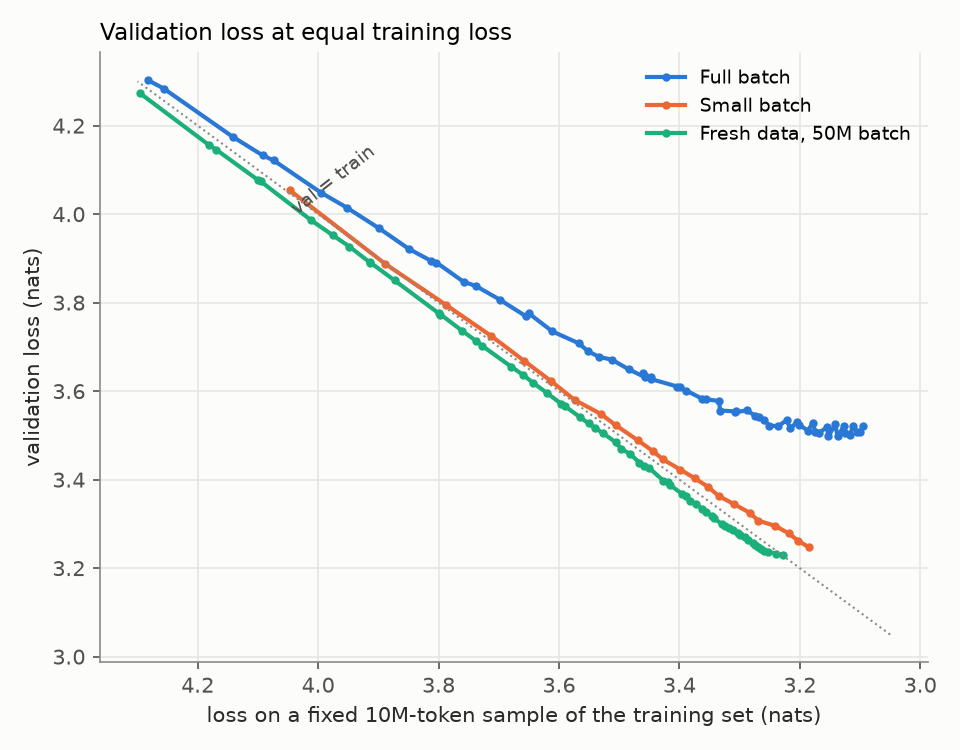
The impetus for doing this was provided in large part by Charles Renshaw-Whitman. Learning dynamics people suggested to me that noise was essential in the training of neural networks. I thought this was kind of counterintuitive--- I usually naively operate from a model in which the pretraining data basically specifies the outcome by virtue of the samples all "pulling" on the loss landscape in some relatively uniform way which incentivizes converging to a point that generalizes well, but instead it seems to be the case that the actual dynamics of the optimization process itself have predictable and measurable effects on the qualitative outcomes of training. The idea seems reasonable based on vague intuitions I have about simulated annealing. I wanted to see directly that this is true at some nontrivial scale, I happened to have access to a pool of free compute that no one else seemed to be using, and I figured this would be an interesting object of study for compute-constrained researchers with an interest in studying learning dynamics closely, so I did some very rough calculations and realized this was feasible to do with GPT-2. The essential result is that on a fixed 800M-token su