Korea’s Stock Market Crashed $1 Trillion. What Does That Mean for the Global AI Race?
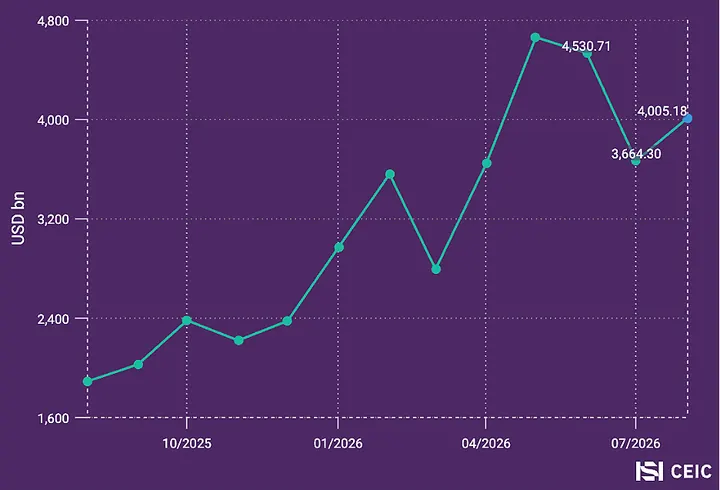
Richard Gray is an analyst who works for a foreign policy think tank in Washington, D.C. Since 2025, South Korea’s capital markets have vacillated from the world’s best-performing to shedding more than $1 trillion in market capitalization. This volatility is a story of how Korea’s financial system overlays supply chain specialization. With Korean firms Samsung and SK hynix controlling a majority share of global memory, South Korea’s stock market functionally operates as a single, highly leveraged node within the AI financial architecture. Two interwoven dynamics explain the convulsions of Korean capital markets and their global ramifications. The first is the Korea discount , in which Korean equities are structurally undervalued because of lagging financial development and weak corporate governance. The second is a memory discount , with each leading high-bandwidth memory (HBM) company (Micron in the U.S., SK hynix and Samsung in Korea) having depressed valuations in their respective markets. The June-July 2026 crash rippled far beyond Korea’s borders and forewarns what may be to come in future market corrections. For Korea, its historically shallow capital markets and exposure to the memory sector — which is now facing emergent Chinese competitors — serve as overlapping pressures on its financial position. In this environment, the threat of a market correction cascading across global markets and the U.S.-China tech competition looms large. The Zenith: Capital Infusion The Korean market is essentially a bet on two companies competing in the same industry. Korea’s memory chip industry has driven exponential year-on-year growth in Korea’s capital markets. From March 2025 to June 2026, the KOSPI — Korea’s main stock index — rose 241%, adding nearly $3.3 trillion in capitalization and exceeding the total increase accumulated over the index’s 43-year history (Bloomberg). In June 2026, SK, Samsung, and Naver announced plans to build chipmaking plants and data center facilities worth $880 billion — a sum adding up to more than 50 percent of Korea’s current annualized GDP. The Korean AI capital boom powered these commitments. In Q1 2026, SK hynix reported a quarter-on-quarter increase in revenue of 60%, while Samsung recorded 40% revenue growth. This concentration bleeds into the global semiconductor supply chain. As of Q2 2026, SK hynix and Samsung collectively accounted for 83 percent of the global HBM market and 63 percent of the dynamic random-access memory (DRAM) market. Micron, the closest American competitor, maintains an 18 percent market share in HBM and 24 percent in DRAM. This domestic and international centralization is one of the clearest financial expressions of the artificial intelligence boom. Alongside SK hynix and Samsung, Micron forms a memory chip triopoly. The emergence of CXMT — a firm with deep state backing from the world’s second-largest economy — introduces risks of China moving up another value chain, accelerating production, and drawing down market pricing. Such a conversion would challenge the position of the incumbent memory players, introducing new risks of shortfalls in valuation that could spread financial contagion across the AI stack. The Nadir: Capital Volatility Korea’s memory chip bet has since faltered. From June 22 to July 16, the KOSPI entered a bear market, shrinking more than a quarter and wiping out nearly $1.1 trillion in market capitalization. (CEIC) SK hynix and Samsung fell 38% and 29% over the same window. (Bloomberg) The June-July bear market was as tied to an industry as a country. Micron’s shares fell approximately a third in the same span, while Chinese and Taiwanese semiconductor stocks also were being sold off . As the Iran war’s reescalation put additional pressure on the Korean economy through currency pressures and rising energy costs, Korean regulators warned of chip-sector concentration as a market risk. As of July 2026, Samsung Electronics and SK hynix alone accounted for more than half of KOSPI’s total market capitalization. In contrast, the Magnificent Seven (seven highest-valued American stocks) taken together are 37.2% of the S&P500. (Morningstar) Throughout the first half of 2026, foreign investments have flowed out of Asian equities at a record pace — with Korea among the hardest hit. In line with the KOSPI’s crash, in May and June, South Korea’s capital flight (in equities) exceeded $35 billion. On July 28, Korea’s stock market dropped more than 8% during intraday trading, the eighth instance that year. There have been at least 33 days of upticks and downturns of more than 5%. In response to the market’s sharp decline, the Financial Services Commission (FSC) suspended sales of leveraged Exchange-Traded Funds (ETFs) tied to individual stocks “until market conditions stabilize,” and tripled the minimum deposit required to trade them to $20,300, effective August 5. While ETFs often are an investment vehicle that holds a broad set of assets, the ones popularized in the Korean market were tied to the performance of single stocks and acquired in high volume through loans. These ETFs let ordinary investors bet on a single company’s stock while magnifying gains and losses. After the ETFs launched in May, trading in SK hynix and Samsung and their ETFs came to dominate the entire Korean stock market, peaking at 84 percent of all volume in June. This volatility is partially powered by South Korea’s shallow capital markets. Historically, Korea’s capital markets have been characterized by a structural undervaluation of listed enterprises known as the “Korea discount.” Financial analysis company MSCI continues to label Korea as an emerging market, citing limited convertibility of the won in the offshore currency market, excessive requirements for foreign securities, and limited investment instruments. Korea’s comparatively low price-to-book ratio — a comparison of stock prices and a company’s net assets — introduces risks that accompany rapid capital market growth. Throughout 2025, Korea had the lowest price-to-book of any of the surveyed markets, well below Hong Kong, Malaysia, or Singapore. Era Dabla-Norris of the International Monetary Fund argues that shallow markets with limited diversification lead to concentrated counterparty exposures, potentially increasing financial stability risks during periods of market deepening. As the KOSPI retains a globally competitive return on equity — how efficiently companies generate profits from shareholder equity — the “Korea discount” is likely driven by a combination of genuine mispricing and governance risk. Caveats to the Memory Momentum Memory has become the highest revenue-generating segment in Korea’s capital market and the global semiconductor supply chain alike. According to Gartner, memory revenue is projected to surpass $1 trillion and account for more than 55 percent of all semiconductor revenue by 2027. The value of South Korea’s DRAM exports has increased more than fivefold year-on-year (CEIC). An increase in memory demand has led to Korea’s semiconductor export volumes more than doubling in that same period. At the same time, there is a global memory shortage. Samsung has earmarked 70% of its memory production for long-term agreements through 2030. This supply-demand imbalance is expected to become more severe through 2028 (JP Morgan). SK hynix CEO Kwak Noh-Jung has stated that the memory shortage could persist through 2030. According to JP Morgan, DRAM prices rose more than 400% from 2024 to 2026, with greater demand and long-term arrangements increasing overall memory pricing and reducing available supply. Historically, memory has been classified as cyclical, requiring intensive capital investments. Competition was primarily on the lines of affordability as opposed to quality, with an ebb and flow in demand and downturns shrinking the number of players within the market. There is an ongoing debate on the extent to which the AI boom has reshaped