Gradium Open-Sources Phonon, a 31M-Parameter On-Device TTS Model Under Apache 2.0
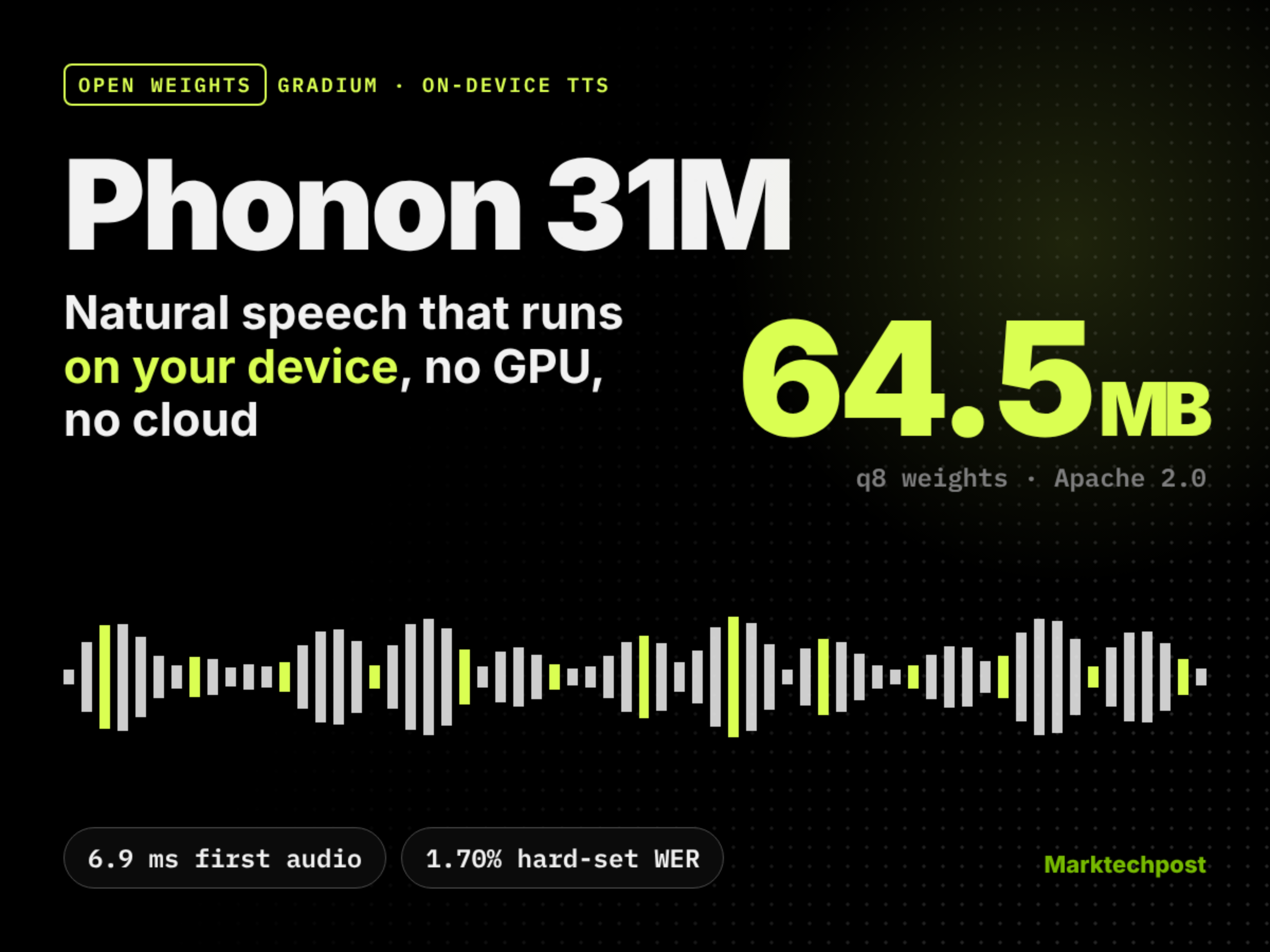
Gradium has open-sourced Phonon , a family of small text-to-speech models built to run on the device. The Gradium Phonon on-device TTS model comes in 31M and 40M sizes. The English Phonon 31m ships under Apache 2.0 and fits in a 64.5 MB file. Developers get natural speech with no cloud call, no GPU and no per-character bill. TL;DR Size: 31M parameters (excluding the audio tokenizer), 64.5 MB q8 GGUF, 24 kHz mono output. Phonon 40m: 40M, 74.6 MB. Runs on: CPUs, phones, Raspberry Pi 5, browsers (WASM, WebGPU) and NVIDIA GPUs. No GPU required. Performance: top English Elo among open models Gradium tested; about 7 ms to first audio on CPU. Best: 1.70% WER on a 500-sentence hard set, versus 3.50% for Kokoro (Gradium’s eval). Worst: 0.51% Seed-TTS LLM WER, behind Kokoro (0.45%) and Magpie (0.46%). What is Gradium Phonon? Phonon is an open-weight TTS family from Gradium , a Paris voice AI company spun out of Kyutai. It generates speech locally on phones, laptops, boards and browsers. The family has three models : Phonon 31m: English only, 37 built-in voices, Apache 2.0. Phonon 40m: 1 model per language (English, French, German, Spanish, Portuguese), CC BY-NC 4.0. Phonon 40m multilingual: all 5 languages in 1 model, 102 voices, CC BY-NC 4.0. How does Phonon work? Phonon uses a causal transformer backbone. Its prefix combines text and speaker embeddings. A SentencePiece tokenizer with a 4,000-token vocabulary reads raw text, with no phoneme conversion. The backbone generates 1 latent vector per 80 ms frame. A flow-matching head turns that vector plus noise into an audio embedding in a single step. A smaller variant of Kyutai’s Mimi decoder then outputs 24 kHz PCM audio. A separate end-of-speech head decides when to stop. Phonon 31m uses 6 transformer layers, width 512 and 8 attention heads. Phonon 40m uses 9 layers at the same width. Both are distilled from a larger Phonon teacher. Training ran on an NVIDIA H100 cluster with NCCL and CUDA Graphs. The work builds on Kyutai’s Continuous Audio Language Models research and Pocket TTS. STEP 2SentencePiece STEP 3Causal transformer STEP 4Flow-matching head STEP 5Mimi decoder Back Next step Stream frames Each bar is 1 latent frame = 80 ms of 24 kHz audio Hard-set WER (lower is better) English Elo (higher is better) Seed-TTS WER Time to first audio6.9 ms Speed vs real time29.9x Gradium blog rows are Phonon 31m; partner and press-release rows do not name the variant. Higher "x real time" means more seconds of audio per second of compute. Measured by Gradium and launch partners. Where Phonon 31m leads
- 1.70% hard-set WER vs 3.50% for Kokoro
- 6.9 ms to first audio on a MacBook Air M5 CPU
- 3.7x real time on a Raspberry Pi 5
- Apache 2.0 weights, tokenizer and voices
- 0.51% Seed-TTS WER, behind Kokoro at 0.45%
- English only at 31M; 40m models are CC BY-NC
- Prosody resets between sentences on long text
- All benchmarks are run by Gradium