MarkTechPost2h agoenergy 108
NVIDIA Releases Nemotron 3.5 Super VL, a 120B Open Multimodal Agent Model
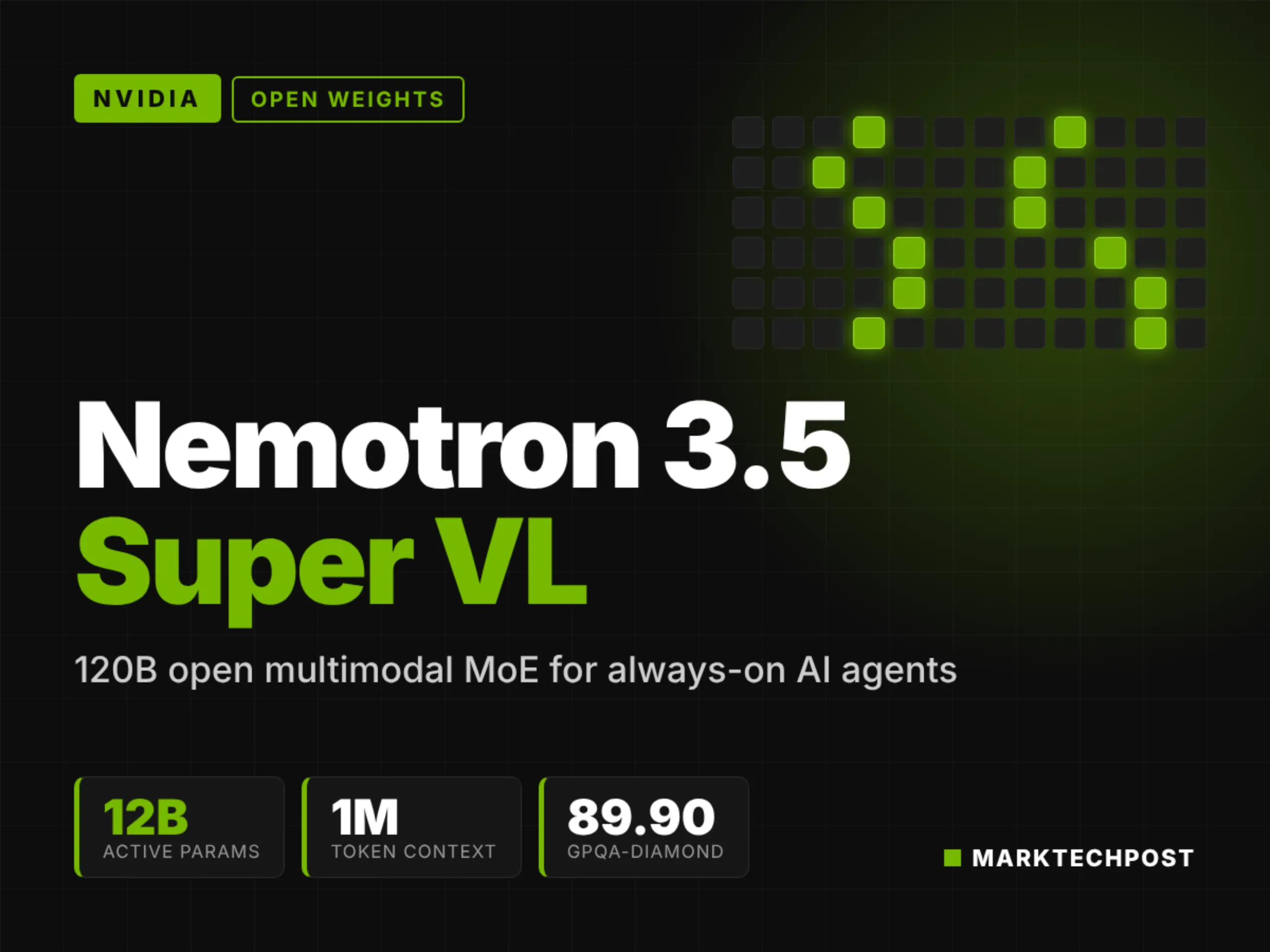
image: MarkTechPost
NVIDIA just released Nemotron 3.5 Super VL , an open vision-language model built for always-on enterprise agents. Nemotron 3.5 Super VL is a 120B-parameter mixture-of-experts model from NVIDIA that activates 12B parameters per token. It reads text, images, documents and video, then reasons, calls tools and writes code in one model. For developers, 1 open checkpoint replaces a separate text model along with a separate vision model. NVIDIA also shipped 2 edge models, Nemotron 3.5 Bolt 74B-A9B and Bolt E4B. TL;DR Size: 120B total parameters, 12B active (MoE). Context up to 1M tokens. Runs on: 1x DGX Spark, 1x H200, 2x H100 or 1x GB200 with the NVFP4 checkpoint. A BF16 checkpoint is also published. Performance: Strong reasoning, agentic coding and document vision. NVIDIA claims up to 5x higher single-GPU throughput than open peers. Best: 89.90 on GPQA-Diamond (NVFP4). Worst: 17.78 on tau3-bench banking (NVFP4). What is Nemotron 3.5 Super VL? It is an open multimodal agent model. Weights ship under the OpenMDW-1.1 license . NVIDIA also released open datasets , training recipes and RL environments in NeMo Gym. The model card lists text, image and video inputs with text output. Video is limited to MP4 clips up to 2 minutes. Reasoning can be toggled on or off through the chat template. How does the architecture work? The backbone interleaves Mamba-2, mixture-of-experts and attention layers. Each MoE layer holds 512 routed experts. A C-RADIO vision encoder and a connector feed images, document pages and video frames into the language backbone. Speed comes from four techniques: Multi-token prediction: a native drafter proposes several tokens, verified in 1 forward pass. LiLiCorr: a speculative drafter for DGX Spark, up to 2.3x faster token generation. NVFP4 with quantization-aware distillation: 4-bit weights and activations on Blackwell, 4-bit weights with 16-bit activations elsewhere. Context reuse: prefix caching keeps both attention caches and Mamba states across agent turns. The model was distilled from Nemotron 3 Ultra. NVIDIA team states that it trained on about 26 trillion tokens. Post-training used roughly 3.8 million samples plus RL across dozens of environments. Continued pretraining added 10B Indic tokens. How does it perform on benchmarks? All scores below are NVIDIA-reported, from the NVFP4 checkpoint on the model card. On agent harness evals, Super VL beats Nemotron 3 Ultra. It scores 63.44% on Hermes Bench versus 56.33%. On LangChain evals it scores 87.05% versus 84.3%. Ultra carries about 4.6x more total parameters. NVIDIA team reports over 600 output tokens per second on Artificial Analysis agentic tasks via a Baseten endpoint. Its chart marks a 5x speed gap over Inkling Small. C-RADIOvision encoder Hybrid MoEMamba-2 + attention MTP decode+ LiLiCorr Outputtext, tool calls Back Next Auto-play Step 1 of 5 NVFP4BF16
read the original at MarkTechPost →
NVIDIA-reported scores from the model card. Orange bar marks the weakest result.
Vendor self-reported scores. Super VL uses NVFP4. Harnesses differ: Inkling-Small SWE-bench uses a bash-only harness.
1x DGX SparkvLLM · LiLiCorr 1x H200vLLM · MTP 3 2x H100vLLM · MTP 3 1x GB200vLLM · MTP 5Commands abridged from the Hugging Face model card. Use the full flag set there for production.
Sources: NVIDIA blog, NVIDIA technical blog, Hugging Face model cards© Marktechpost