Uncertainty in the Verbalizable Workspace
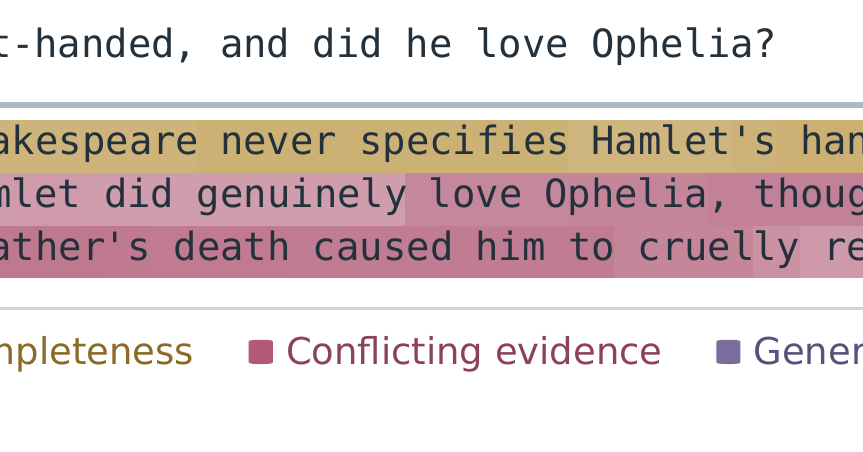
Epistemic status: We found useful uncertainty signal in three reasoning models. All experiments were run on three seeds and are fully reproducible. Whether the same approach can become a broader tool for monitoring models is still an open question. Lingo might include “intend” or “conscious” and has to be taken with a grain of salt. TL;DR: We provide an uncertainty estimation method for reasoning models. Building on the J-lens, we construct four orthogonal directions in a model’s hidden-state space: ambiguity , incompleteness , conflicting evidence , and general uncertainty . Together, these directions span the U-space . As the model reasons, we measure how closely its hidden states align with each direction. Paired with the average entropy of the model’s next-token probability distributions across reasoning tokens, this yields the U-lens. Its readout helps us spot answers that are more likely to be wrong. Surprisingly, just counting the tokens in a model’s reasoning gives us a good indicator of whether the final answer is right or wrong. Wrong answers tend to come with longer reasoning traces. To mitigate this potential shortcut, we also compared traces of similar length, and the