[AINews] Agents disprove Polysemanticity; greatly improve Interpretability & Alignment
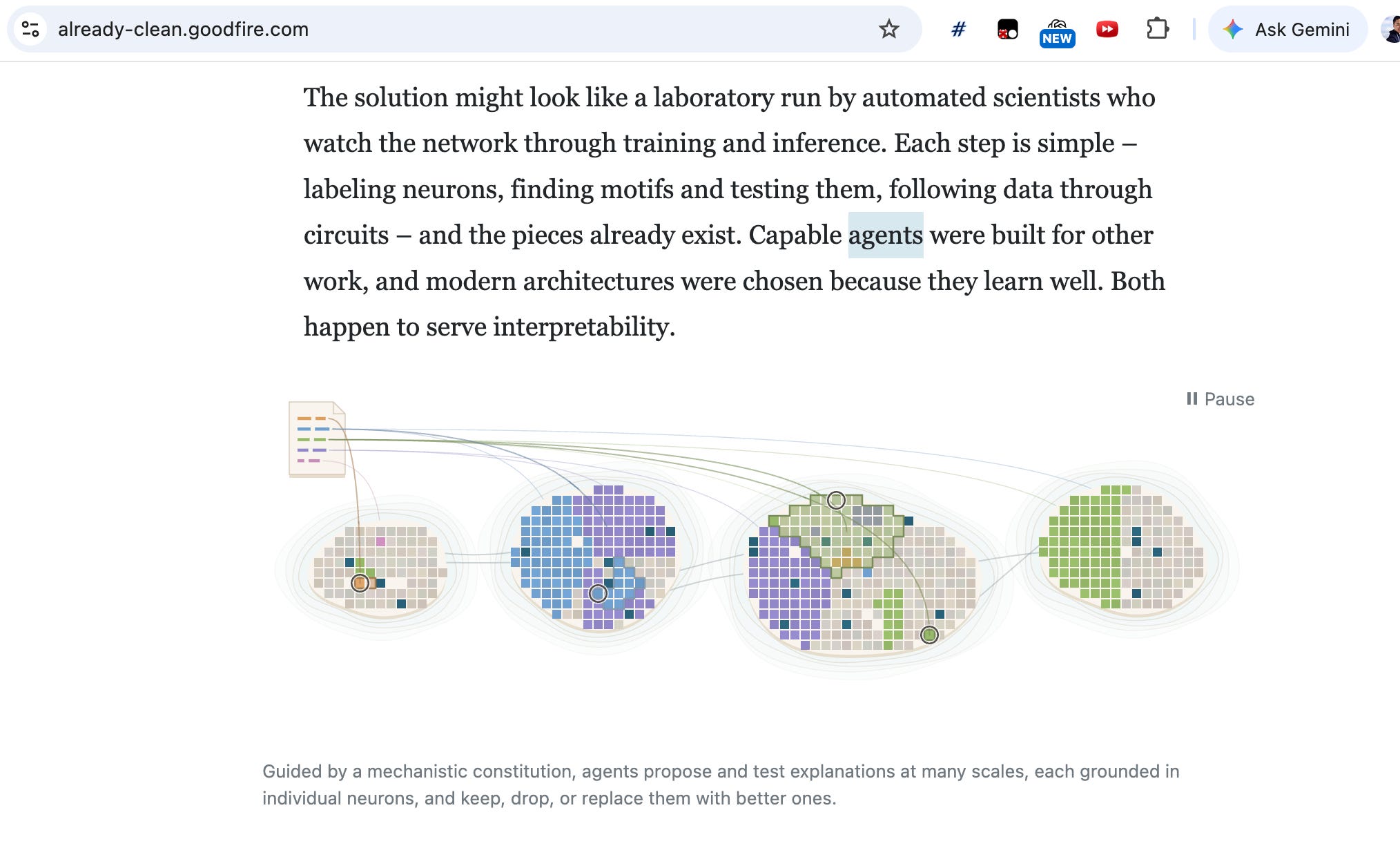
A version of Muse Spark Open was released today, fulfilling their original promise but with a model weaker than their Spark 1.3. It’s also worth watching the Tesla Roadster demo - not strictly AI but nothing cooler than real life flying cars. Our title story today is a rare one on interpretability and alignment. We last caught up with Goodfire in Feb : and the bitter-lesson scaling of interpretability methods with Anthropic last year : And now Nick Cammarata at Goodfire has an important essay out stating his working theory that “ Neural Networks Are Already Clean ” — showing that many known cases of polysemanticity and superposition - causing tangled “knots” of weights that resist human interpretation - simply fall to further agentic analysis: Don’t take our word for it: and a global lowering of P(doom) seems worth celebrating: AI News for 10/14/2026-10/15/2026. We checked 12 subreddits, 544 Twitters and no further Discords. AINews’ website lets you search all past issues. As a reminder, AINews is now a section of Latent Space . You can opt in/out of email frequencies! AI Twitter Recap Meta Releases Muse Spark Open, the Top-Scoring US Open-Weight Model Release : Meta released Muse Spark Open, an 816B-total / 42B-active MoE with a 1M-token context window. It accepts text, image, video and audio input and is aimed at coding, long-horizon agents and multi-step reasoning ( announcement , Wang thread ). Lineage : Jack Rae says it was the first base model trained under the new MSL org, with additional training for the open release ( Rae ). Several posters describe it as roughly Muse Spark 1.2 level ( Yuchen Jin , TimDarcet ). License : The weights ship under the custom Muse Model License. It requires “Built with Muse Spark Open” attribution and a separate agreement for Model-as-a-Service businesses with more than $20M in annual revenue ( AA ). Nathan Lambert called the license “trash” ( natolambert ). Architecture : According to vLLM, the model has 62 decoder layers, all MoE, with 256 experts per layer and 8 active per token. A latent-MoE pooler projects the hidden state from 8,192 to 4,096 for expert computation and back again. Attention is hybrid: 46 layers use a 2,048-token sliding window and 16 attend to the full context. Image and video go through a Perception Encoder, and audio uses a separate 118M encoder ( vLLM arch ). Design comparison : Elie Bakouch notes that Muse is the only major US open model without shared experts. It also uses gated residuals, about 9 norms per layer and muP-like multipliers, including a router factor of 1/sqrt(number of experts) ( overview ). Independent measurement : Artificial Analysis scores it 39 on its Intelligence Index. That ranks it first among US open-weight models but behind GLM-5.3 (45) and Kimi K3 (44) ( AA , Rundown ). Strengths : It uses 40k output tokens per index task, the fewest among the nine highest-scoring open models. It also leads open models on AA-Omniscience (25). Weaknesses : It ranks last among those nine on the index’s four agentic evaluations. GLM-5.3’s entire 6-point lead comes from that agentic segment. Pricing and deployment : Launch pricing on Together, Fireworks and Baseten is $1.25/$4.25 per 1M input/output tokens ($0.15 cached input). AA calculates this at $0.84 per index task, versus $2.01 for GLM-5.3 and $0.27 for DeepSeek V4.1 Flash. Together offers a free endpoint until Oct 18 ( Together ). Hardware footprint : BF16 weights are about 1.6TB. The NVFP4 checkpoint quantizes only the experts and comes to about 530GB, which runs on 4× Blackwell Ultra, 8× H200, or two 512GB M5 Ultra Mac Studios via MLX ( AA , Meta ). Ecosystem : llama.cpp had GGUF support on day 0 ( Delangue ), and Unsloth published quants, with UD-IQ1_S at 176GB ( Unsloth ). vLLM day-0 stack : vLLM support covers NVIDIA, AMD MI355X (FP8 and MXFP4) and TPU ( vLLM ). TPU throughput : Megakernels with DSpark speculation (acceptance length 6) exceed 650 tok/s on 4 TPU v7 chips and 960 tok/s on 8 ( hardware ). Speculator : Inferact trained a block-diffusion DSpark drafter that proposes up to 7 tokens per pass ( speculator ). LoRA RL : LoRA GRPO uses verl for training and vLLM for rollouts. Over 150 steps on 16 GB300s, AIME-2024 mean@8 rose from 0.56 to 0.85, with train-rollout KL around 2×10⁻⁴ ( RL ). Reception : Lambert says the release cuts the US–China open-model gap by about half ( natolambert ). Teortaxes calls it “grim at this param count” with “obsolete attention” and notes that Spark 1.3 is substantially stronger; these are attributed opinions ( teortaxes , Spark 1.3 comparison ). Other Model Launches: Nemotron 3.5, MAI-Base-2, Gemini 4 Argon, Image Models NVIDIA Nemotron 3.5 Super VL : The model is a 120B / 12B-active hybrid Mamba-Transformer MoE VLM with a 1M-token context window and native MTP ( NVIDIA ). Training recipe : The tech summary describes a 1T-token distillation from a larger Nemotron 3 teacher, followed by agentic SWE mid-training on 65.4B tokens at 256K context. Post-training uses multi-teacher MOPD, and a final MTP-boosting step raises acceptance length by 21.8% to 4.61 ( Gordić ). Claimed results : NVIDIA reports 51.78% on SWE-bench Pro and 4,856 output tok/s per GPU on GB200. Independent evals : AA scores Super VL 26, the leading US open model before Muse, with NVFP4 within 0.1 points of BF16. The companion Nemotron 3.5 Bolt (74B-A9B, native 2-bit, 24GB) scores 21 ( AA ). Pricing : CoreWeave charges $0.25/$1.50 per 1M input/output tokens ( CoreWeave ). Microsoft MAI-Base-2 : Microsoft says it has a roughly 3T-parameter pre-trained base model, with post-training results to follow. It claims to match DeepSeek-V4-Pro-Base on held-out code with 12× less training compute ( Suleyman , compute claim ). Technical blog details : The model has about 80B active parameters and a hybrid sliding-window design. It was trained with Muon and activation-gradient clipping on about 40T text tokens plus 10T multimodal tokens, using LR and weight-decay scaling laws ( Bakouch ). Training compute : The run used 16k GB200s over 38 days ( scaling01 ). Disputed comparison : Bakouch and teortaxes note that the bits-per-byte comparison uses MAI’s own validation data ( caveat ). Gemini 4 Argon evals and rollout : Epoch puts Argon at 165 on its Capabilities Index (ECI), level with Fable 5.1 and behind Opus 5.5 (167) and GPT-6 Astra (166). It ranks 8th on Math ECI and 6th on SWE ECI ( Epoch , domains ). ARC-AGI : Argon scores 97.5% on ARC-AGI-3 with a provider harness ($4.8K) and 49.8% with the standard harness ( ARC Prize ). Skepticism : Scaling01 argues that Argon underperforms on reliability and hallucination evals ( scaling01 ). Google claims : Argon optimized Gemma 4 E2B to a 2.85× vLLM speedup on A100, with 100% token parity ( Google ). Availability : Argon is now available in Antigravity for Pro subscribers, with a separate weekly quota ( Antigravity ). Anthropic and OpenAI product updates : Opus 5.5 fast mode : Fast mode is now GA with no waitlist, delivering up to 2.5× speed at $8/$40 per 1M tokens ( ClaudeDevs ). Claude Code Review : Code Review is GA for Team and Enterprise plans, with Quick, Standard and Deep levels ( ClaudeDevs ). GPT-Live-1.1 : OpenAI’s voice update adds multilingual voices and cuts filler, rolling out to ChatGPT, Codex and dots, with the API coming later ( OpenAI ). Image models : FLUX 3 Image Klein : Black Forest Labs released a 5.6B open-weight model with native 4K output, bounding-box control and multi-reference editing ( BFL ). Krea 3 : Krea claims 2K edits in under 8s at $0.06 per image ( Krea , pricing ). Interpretability, Safety and Eval Integrity Goodfire’s “already clean” essay : Nick Cammarata argues that most neurons in models up to trillions of parameters are legible. His 2023 OpenAI automated-interpretability effort found only about 2% legible, and he says many famous polysemantic examples were misread ( Cammarata , Goodfire ). Endorsements : tszzl and others called it a major moment (