MarkTechPost1h agoenergy 110
Meet Drex Max: Nace AI’s Multimodal Decision Model for Computer-Use Agents with a Score 67.59
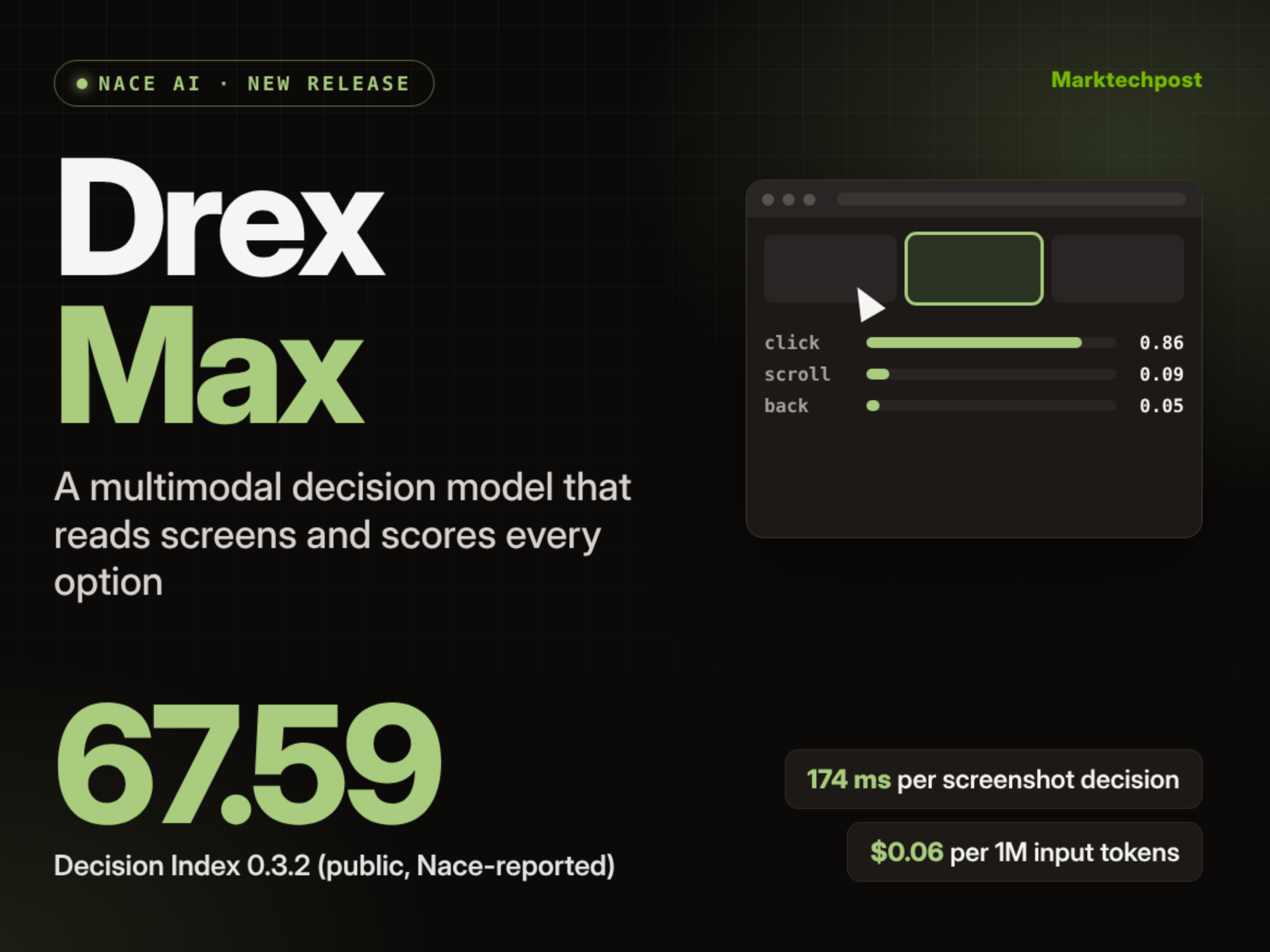
image: MarkTechPost
Nace AI has released Drex Max , a multimodal decision model for agents that use computers and browsers. The Drex Max multimodal decision model reads text and images and returns calibrated probabilities. It writes no text. Nace team reports 67.59 on the public Decision Index 0.3.2 , 6.9 points above TypeSafe’s Jev 1.14. For agent builders, that means one cheap, typed call per click. TL;DR Size: Parameters not disclosed. Up to 262,144 tokens per question on the API, including image tokens. Runs on: Hosted API only ( drex-max on Nace Console). No open weights or quantized builds announced. Performance: 67.59 on Decision Index 0.3.2 (public), the top score Nace lists for any decision model. Best: 98.2 on BFCL tool calling, and 92.2 on JevBench versus 86.7 for Jev 1.14. Worst: 19.0 on HLE, and 72.5 on MMLU-Pro versus 82.1 for Jev 1.14. What is Drex Max? Drex Max is a decision model from Nace AI that answers typed questions about text and images. It is the most accurate model in the Drex family , and the only one that reads images. A decision model does not generate tokens. You send a state and named questions. Each question is one of 3 types: noul (yes/no), choice (pick a label) or score (ordered scale). The model returns a probability distribution for each answer in 1 HTTP call. Drex can only answer with the options you gave it. How does Drex Max work with images? Drex Max uses the same POST /v1/systemone endpoint as every Drex model. You select it with "model": "drex-max" . It is a pinned ID, so drex-latest does not route to it. Images go in an images array. Every question sees the same images, before the state and questions. You refer to them as ‘Image 1’ and ‘Image 2’ in plain text. Each entry is either an uploaded workspace file or inline base64. Key image rules from the Drex Max guide : Formats: still PNG, JPEG or WebP. Up to 8 images per request, 16 MiB each, 32 MiB total. Each image is resized to at most 1,638,400 pixels (1,280 × 1,280). Each image costs up to 1,602 tokens in every question. Up to 16 questions per request, with a 4 MiB request body. How does Drex Max perform on benchmarks? All scores below come from Nace’s Drex page . They are self-reported. Nace says Drex trains on the index’s official training splits and is scored on held-out splits. Decision benchmarks : Drex Max scores 67.6 on the public Decision Index 0.3.2. Jev 1.14 scores 60.7 and Drex 2.0 scores 61.3. On JevBench, Drex Max reaches 92.2 against 86.7 for Jev 1.14. Agentic benchmarks : Drex Max posts 0.780 on OSWorld-Verified and 98.2 on BFCL. It scores 85.2 on When2Call and 84.8 on RAGTruth. Vision : On the Decision Index Vision public suite, Drex Max scores 74.5. GPT-6 Luna Decisions scores 63.9. Mind2Web reaches 88.6 and InfographicVQA reaches 98.8. Where it trails : Jev 1.14 leads on MMLU-Pro (82.1 vs 72.5), HLE (19.4 vs 19.0) and ARC-Challenge (97.6 vs 97.4). On Hateful Memes, Drex Max trails GPT-6 Luna Decisions, 70.6 vs 71.2. Back Next step Auto play
read the original at MarkTechPost →
Answer probabilities are an illustration of the response shape, not real model output.
Decision Index Agentic Vision BenchmarkDrex MaxJev 1.14ResultAll figures from Nace's Drex page (self-reported). Jev 1.14 rejects 15.9% of screenshots by size, per Nace.
Tap a card for detail. Source: Nace Drex Max API guide.
Decisions per day: 10,000 Screenshots per decision: 1 Text tokens per decision (state + question): 500 Estimated daily cost, upper bound $0.00 Uses $0.06 per 1M input tokens and the 1,602-token maximum per image. Output tokens are not billed. Real image token counts can be lower. Sources: nace.ai/drex · Drex Max guide © Marktechpost