Detecting NSFW and Harmful Prompts Through Geometry: Learning What's Safe Instead of What's Harmful
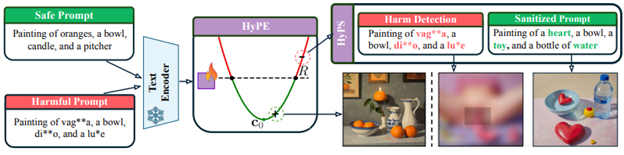
⚠️ Content warning: This post contains potentially offensive text and images from our research paper, included solely to illustrate the safety risks associated with vision-language models. TL;DR: i) Can we detect harmful prompts by learning only what safe prompts look like? ii) In our ICLR 2026 paper, we introduce HyPE , a lightweight detector that uses hyperbolic geometry and learns just a single parameter from benign prompts. It shows strong detection performance, even against adversarial attacks. iii) We also introduce HyPS , a prompt sanitizer that identifies and replaces harmful words, making prompts safer while preserving much of their original meaning. Introduction Vision-language models are becoming increasingly powerful, but preventing them from producing harmful content when prompted by malicious users remains a major challenge. Most existing NSFW and harmful prompt detectors try to recognize these prompts using predefined rules, blacklist filters, or heavy classifier-based systems. However, attackers can often evade detection by rewording prompts, paraphrasing them, or adversarially optimizing them while preserving their harmful intent. For simplicity, throughout this po