How Earth Lost a Billion Years of Its History
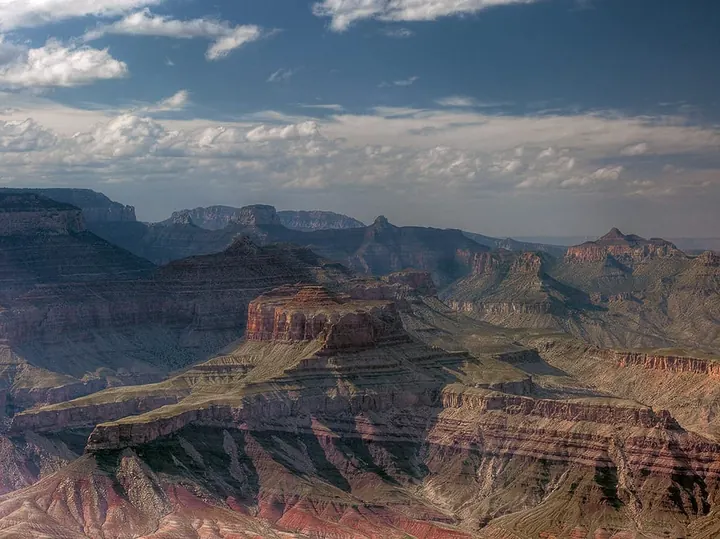
Welcome back to the Abstract! Here are the studies this week that drew a blank, felt the squeeze, played the queen, and made donkey-bull love. First, scientists shed new light on how Earth ended up losing more than a billion years of its geological record, a puzzle that has resisted explanation for decades. Then: octopuses in tight spots, a topless spear-brandishing Celt, and a tale of unlikely tail. As always, for more of my work, check out my book First Contact: The Story of Our Obsession with Aliens , or subscribe to my personal newsletter The BeX Files . “Blank Space” (Earth’s Version) Dhungana, Santosh and Flament, Nicolas. “The deep Earth origin of the Great Unconformity. Nature. Earth doesn’t trouble itself too much with keeping intact archives. With its tectonic activity and erosive forces, our planet is constantly wiping out huge chunks of its own memory, creating gaps in the geological record called unconformities. The Great Unconformity, the largest gap of this kind, reveals that Earth straight-up deleted more than a billion years of strata, for reasons that remain hotly debated and mysterious. Sandstone that dates back to the Cambrian period some 538 million years is often found directly on top of ancient “basement” rocks that date back anywhere from 1.2 billion to 1.8 billion years ago. This missing layer shows up around the world, hinting that it was erased by a global event. Now, scientists have placed the origins of the Great Unconformity deep inside Earth’s mantle, during the tectonic tumult of supercontinent breakup. “The cause or causes of the Great Unconformity are unknown,” said authors Santosh Dhungana and Nicolas Flament of the University of Wollongong. “The proposed mechanisms include extensive glacial erosion during Snowball Earth (about 720–635 million years ago), rifting and plume activity, sea-level fall and mantle-driven dynamic topography.” “These processes have not been dynamically tested, with limited comparison between global models and global datasets to explain the spatial distribution of the Great Unconformity,” the team added. To fill the knowledge gap about the geological gap, the researchers ran models of the formation and breakup of ancient supercontinents during the eons preceding the Cambrian period, when complex life rapidly proliferated in Earth’s seas. Massive landmasses were pushed upward by motions in Earth’s mantle during this time. Exposed to erosive forces such as weather, glaciers, and eventually oceans, they became sanded down over time, creating the vast void. “Our models explain why the Great Unconformity is best preserved in North America and show that it is a first-order surface expression of deep geodynamic processes that transformed global landscapes and sediment fluxes,” the team concluded. Scientists will no doubt continue to debate the cause of this planet-wide memory lapse, but there is consensus that the same mechanisms also set the stage for the emergence of complex life during the Cambrian. No matter what caused the Great Unconformity, we partly owe our existence to it today. In other news... Putting the squeeze on octopuses Xin, Wenci et al. “Overcoming environmental constraints: octopus uses 3-step or 4-step strategies to squeeze through small holes.” Journal of Experimental Biology. We’ll move now from massive gaps in Earth’s memory to tiny gaps that octopuses can somehow squeeze through. These tentacled escape artists can famously maneuver their way through passages that seem impossibly small relative to their bodies, an ability that has spawned a subgenre of viral videos. Now, scientists have discovered the secrets of “octopus-squeezing behavior” by observing two species—the common octopus ( Octopus vulgaris ) and the Mayan octopus ( Octopus maya )—navigating small holes in laboratory containers. “Our study demonstrates that octopuses employ two primary strategies, 3-step and 4-step, for squeezing through narrow spaces,” said researchers led by Wenci Xin of the National University of Singapore. “The key distinction between these strategies lies in whether the body is squeezed separately from the arms.” The first two steps were probing the aperture and then shifting a few arms through it. Navigating the tightest spaces required breaking up the final passage into two parts: Pulling the remaining arms to the other side, and then compressing the mantle behind the head so they could fit through last. In addition to documenting these amazing feats of flexibility in nature, the study is the perfect excuse to revisit the classic X-Files episode “Squeeze.” A queen hidden in plain sight? Russell, Miles. “Verica Rex: Searching for a ‘lost’ queen of the British Iron Age.” Current Archaeology. When Rome invaded Britain 2,000 years ago, they had the help of an inside man—or was it an inside woman ? In a new article, an archaeologist makes the case that the British king Verica, who aided the Roman invasion of their own homeland, was actually a queen that has been misgendered lo these many centuries. Miles Russell of Bournemouth University argues that Verica was a woman based in part on the leader’s Latin name, which ends in the suffix “a” which is common for women, as opposed to names ending in “-us” for men. Coins also depict Verica using “slender, bare-breasted equestrian figures that appear irrefutably female in contrast to the overtly masculine warriors on the issues of Iron Age rulers like Tasciovanus and Caratacus,” according to Russell. Many experts are not convinced that the evidence points to a secret ancient queen, and Verica’s gender is likely to inspire much more debate. Wikipedia, our great public arbiter, has not changed Verica’s male pronouns . Women leaders weren’t unheard of in Celtic Britain, as evidenced by the queens Cartimandua and Boudica, who lived in the same century as Verica. Regardless of whether Verica was among their ranks, this leader was a consequential figure in the Roman takeover of Britain. Achille and Patroclo: More than friends Da Cruz, André B et al. “A socio-sexual bond between a bull and a male donkey.” Current Biology. Scientists who were conducting fieldwork on monkeys in Ethiopia serendipitously stumbled upon a very different discovery—a tender same-sex relationship between a bull and a donkey. Achille, a bull, and Patroclo, a donkey, belong to different owners, but they graze together by day. Despite the availability of other males and females in their pasture, this pair has developed a strong socio-sexual bond that includes nuzzling, licking, and Achille sexually mounting Patroclo. “Patroclo frequently presented his hindquarters toward Achille and nipped him,” said researchers led by André Beirão da Cruz of the University of Pisa. “In the only two instances in which Achille approached and mounted another male donkey, this individual showed clear avoidance behaviours and displayed threatening facial expressions (e.g. ear flattening), which were never observed in Patroclo during the 51 mountings (34 with intromission) with Achille.” Same-sex sexual behavior is extremely common in nature and has a wide variety of possible explanations, including social cohesion, mistaken identity, or lack of access to opposite-sex mates. But what Achille and Patroclo have is special. Despite being different species and having alternate mating options, the pair share a highly selective and reciprocal social and sexual bond. “Although interpreting this behaviour is challenging, the mounting attempts, taken together with the repeated and mutual affiliative interactions between the two animals, may signal the quality of their relationship” and “the strength of the animals’ social bond,” the team concluded. In addition to this heartwarming tale, the study goes to show that you never know what you might find when you chase your goals. The researchers were there to watch geladas, but it turned out those primates weren’t the only animals monkeying around. Thanks for reading! See