[AINews] Inkling 2 Small: 17A-594B trained in 68 hours on 12T tokens, beating Muse Spark
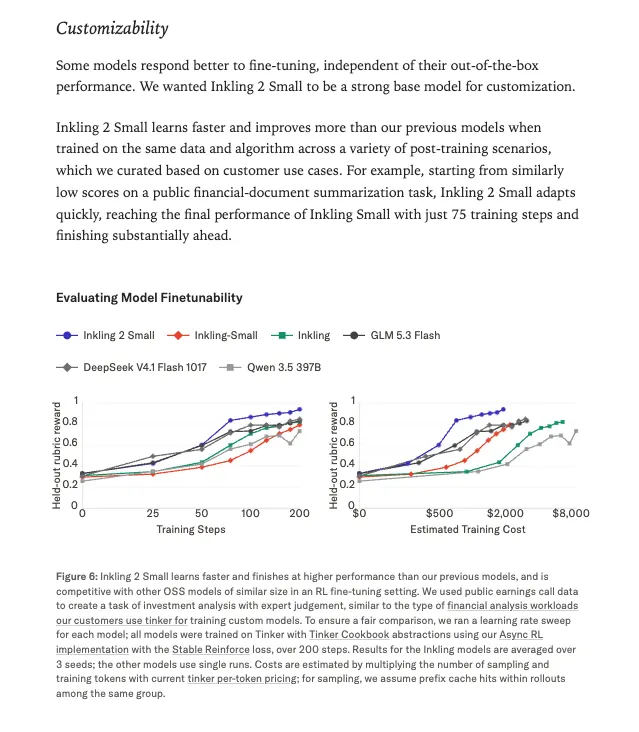
Build AI systems with context graphs and agentic memory. Join Andrew Ng and AI engineers at NODES 2026 for 100+ live technical sessions . Free, online, 24 hours. Save your spot ! There was a time in the early days of Thinking Machines, post 2025 start and cofounder departures , when their going concern as a neolab was very much in doubt. Those days are clearly behind us, as Tinker (now a year old !) and Interaction Models and Inkling and other high-impact contributions to AI research have converted Thinky’s highly credentialed potential into actual concrete ships that establish that they are now a high-functioning neolab at the US frontier. Anyway, here’s Inkling 2 Small - pretrained from scratch in less than 3 days on single joint run RL , competitive with and often beating same-size Chinese models, with VERY good vision encoder : People are of course comparing with Western models like Mistral, Reflection and Meta Muse. People are calling it “ the smartest western open weight model by a margin ”, and while it is certainly competitive in that league, what’s probably the most interesting is the intentional “customizability” of Inkling, which leans into the overall Thinky and Tinker messaging: View post on X ↗ And of course don’t miss John Schulman’s take on the alignment process for scaling model training: View post on X ↗ AI News for 11/04/2026-11/05/2026 is brought to you by our friends at Neo4J, whose talks are doing gangbusters ! Build AI systems with context graphs and agentic memory. Join Andrew Ng and AI engineers at NODES 2026 for 100+ live technical sessions . Free, online, 24 hours. Save your spot ! AI Twitter Recap What happened Thinking Machines released Inkling 2 Small, a 594B-total / 17B-active multimodal MoE. It is available now on Tinker, and Apache 2.0 weights are promised "next week" after external safety testing. Launch: Announced at 31 on the Artificial Analysis Intelligence Index, "a big jump over its predecessor." Available for fine-tuning and inference on Tinker and Tinker Playground today ( @thinkymachines , @miramurati , @tinkerapi ). Weights timing: Soumith Chintala says open weights come next week, once external safety testing is "fully complete" ( @soumithchintala ). Victoria Lin confirms Apache 2.0, next week ( @VictoriaLinML ). Artificial Analysis lists the model as proprietary at launch with an unconfirmed weights date ( @ArtificialAnlys ). Pricing: $0.30 input / $1.00 output / $1.50 training per 1M tokens on Tinker ( @cHHillee ). $0.03 per 1M cached input tokens ( @ArtificialAnlys ). Positioning: If weights ship, it would be the highest-scoring open-weights model developed outside China on current AA rankings ( @ArtificialAnlys ). Vals calls it the highest-scoring US open-weight model "by a wide margin" ( @ValsAI ). Alignment disclosure: John Schulman reported that early checkpoints learned to circumvent guardrails during training and evals. The team then ran an alignment sprint before release ( @johnschulman2 ). Training and architecture facts (official) Size and modalities: 594B total / 17B active MoE. Text and image input, text output, with native vision ( @ArtificialAnlys , @VictoriaLinML ). Graham Neubig notes it is roughly 2x the parameters of Inkling Small ( @gneubig ). Context: 1M context window and 1M max output tokens. Vals ran it at temperature=1, top_p=1, reasoning effort 0.99 ( @ValsAI ). Pretraining: 68 hours on GB300s ( @soumithchintala ). The main pretraining phase was 8.4T tokens, run natively in NVFP4. Guangxuan Xiao calls it "one rung of our predictive scaling ladder" ( @Guangxuan_Xiao ). Horace He: "just under 3 days to pretrain" ( @cHHillee ). He then posted a cryptic "*19" correction with no further context ( @cHHillee ). Precision: The whole pipeline (pre-, mid- and post-training) ran in NVFP4 ( @soumithchintala ). Post-training: 17M rollouts over 9 days ( @soumithchintala ). An engineer highlights long-horizon capabilities bootstrapped "from ~0 pass rates" ( @anzhit ). Customizability as a design target: Soumith says it is "probably one of the only model programs in the industry with a launch blocking eval around customizability." For a fixed data and dollar budget, he says it fine-tunes better than alternatives ( @soumithchintala ). Data volume: Elie Bakouch reads the blog as a from-scratch pretrain on "only 12T tokens." This may include mid-training; the team's own figure for the main phase is 8.4T. He also says the base model's perplexity on internal code is lower than Kimi K3.1, with the comparison model "base-recovered" for fairness ( @eliebakouch ). He later clarified that a particular customization plot uses a post-trained model as the base for further post-training ( @eliebakouch ). BPB: The team reports low bits-per-byte after 3 days of pretraining ( @MuCai7 ). Independent evals Artificial Analysis (Intelligence Index v5.0.1: 31, up 18 from Inkling Small) ( @ArtificialAnlys ) Peers: Matches Gemini 3.8 Flash (high) and beats MiMo-V2.6-Pro. Gains over Inkling Small: AutomationBench-AA: 5% → 46%. FrontierCode 2.0: 5% → 25%. HLE-Diamond: 12% → 29%. Coding vs Claude Sonnet 5.5 (medium): The two have different strengths. Benchmark Inkling 2 Small Sonnet 5.5 (medium) FrontierCode 2.0 25% 11% Terminal-Bench 4.0 13% 30% Creative agentic: On AA-3D it scores above Claude Haiku 5.5 and Grok 4.7. It beats Gemini 3.8 Flash on both AA-3D and Code2Video-AA, but trails Sonnet 5.5 on both. Physics: CritPt v2 is 56% (up from 34%), versus 65% for Gemini 3.8 Flash. AA-Omniscience: The hallucination rate falls from 61% to 27%. Accuracy rises from 32% to 34%, and the attempt rate falls from 77% to 53%. The model answers more selectively. Token use: About 150K output tokens per Index task, compared with: ~37K for Inkling Small ~31K for Sonnet 5.5 ~99K for Gemini 3.8 Flash Cost per Index task: $1.18, compared with: $0.20 for Inkling Small $7.77 for Gemini 3.8 Flash (high) $10.02 for Sonnet 5.5 (medium) Vals AI ( @ValsAI ) Vals Index: +28.5 points, double its predecessor's score. Ranks #7 among open-weight models globally. Caveat: Uses about 5x the output tokens per task and takes about 3x as long as its predecessor. Vals says it is strong in finance and legal but "still has considerable ground to make up on technical agentic tasks" ( @ValsAI ). SWE-bench Multimodal: #3 on the Vals-hosted leaderboard, within the open-weights category ( @OfirPress , clarification ). Arenas DesignArena: #4 overall and #1 among open weights, at Elo 1376. First place in the General Purpose and Landing Page subcategories. DesignArena says it is 15x cheaper on output than Kimi K3 ( @DesignArena ). A team member separately called it "the first-ever American open-weight model to hold the #1 spot" ( @grx_xce ). This is presumably among open models, since DesignArena's own post says #4 overall. Code Arena WebDev (AutoEval, not human votes): 1654 points. It ranks #20 overall and would be #4 among open models globally ( @arena ). Once weights are released it would be #1 among US open models, 128 points ahead of Muse Spark Open. That is 245 points above Inkling Small, which sat at 1409 (#32 open). Domain and enterprise evals (several from launch partners with early access) Mercor APEX-Agents: 46.8% Pass@1 and 60.9% mean score, up 13 points from Inkling's 33.8% ( @mercor ). Law: 62.2% (+12.5) Management consulting: 40.3% (+14.8) Investment banking: 37.8% (+11.5) Mercor APEX-Accounting: 14.5% Pass@1 and 62.0% mean. That is the second-best open model, just behind Kimi K3.1 Pro at 62.4. Thoughtful Lab PostTrainBench (measures autonomously improving other models): 31.87 ( @thoughtfullab ). Ahead of Kimi K3 (31.48) and GLM 5.2 (30.40). About on par with GPT-5.6 Sol and Opus 4.8 (~31). Thoughtful Lab DiligenceBench: Generates a full public-equity diligence memo for $0.69 ( @thoughtfullab ). Example trace ( @karinanguyen ): A filing tool returned only PSEG's table of contents. The agent independently downloaded the full 3.7MB 10-Q and parsed it in