MarkTechPost2h agoenergy 107
NVIDIA Releases Nemotron 3.5 Bolt E4B 4GB: An Open Small Language Model for Local Voice Agents, Game Characters and Robots
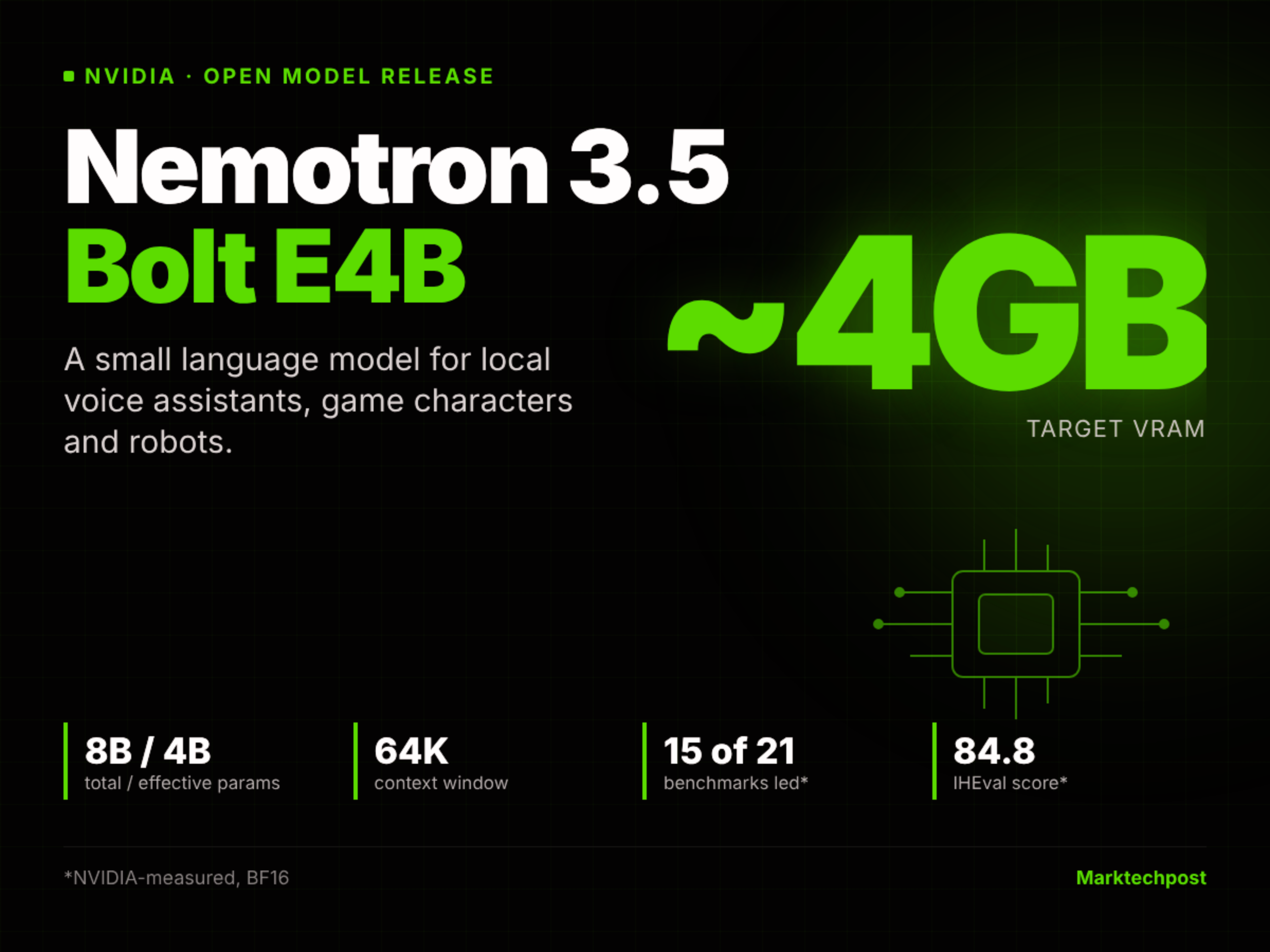
image: MarkTechPost
NVIDIA has just released Nemotron 3.5 Bolt E4B 4GB , an open small language model for fast conversational agents. It targets voice assistants, game NPCs and robot interfaces running locally on RTX, Jetson and Spark hardware. The model is post-trained from Google’s Gemma 4 E4B using reinforcement learning only. For developers, this is agent behavior in about 4GB of VRAM. That leaves room for speech and vision models. TL;DR Size: 8B total parameters , 4B effective, 64K context. Runs on: GeForce RTX, Jetson, RTX Spark and DGX Spark. The Q4_K_M build used 3.1 to 4.3 GB VRAM on RTX in NVIDIA tests. Performance: Top score on 15 of 21 benchmarks against Gemma 4 E4B, Qwen3.5-4B and Nemotron 3 Nano 4B (NVIDIA-measured). Best: IHEval 84.8, versus 67.0 for Gemma 4 E4B and 60.6 for Qwen3.5-4B. Worst: Tau2-Bench 55.1, about 20 points behind Qwen3.5-4B at 75.1. What is Nemotron 3.5 Bolt E4B? Nemotron 3.5 Bolt E4B is a small language model from NVIDIA that powers local conversational agents. It combines natural dialogue with multi-turn tool calling. NVIDIA lists 3 target workloads: device and voice assistants, interactive characters, and embedded or industrial agents. The research report shows a Reachy Mini robot running on a Jetson Orin Nano 8GB. In that demo, Cosmos 3 Edge handles vision while Bolt handles speech replies and tool calls. NVIDIA team also calls Bolt the third-generation small model for NVIDIA ACE game characters . Core features from the launch post : Multi-turn tool use, with guidance for asynchronous tool calls. A conversational_mode flag for short, speech-ready replies. Configurable reasoning, plus a runtime thinking budget to cap latency. 64K context for history, tool definitions and application state. How was Bolt E4B trained? NVIDIA skipped supervised fine-tuning entirely. As per the research report , SFT improved tool calling but hurt Gemma’s conversational quality and verbosity. Instead, the research team used RLVR and RLHF through NeMo-RL and NeMo-Gym . Every training sample ran in both reasoning and non-reasoning modes. Each batch kept a 2:1 ratio of non-reasoning to reasoning samples. Length penalties in the GenRM environment stopped answers from growing during training. The datasets and the full recipe are public. For deployment, NVIDIA quantized the BF16 checkpoint to Q4_K_M with importance-matrix calibration. Calibration used about 1M tokens of RL rollouts. The release also ships a DFlash drafter for speculative decoding. On an RTX 5070, Bolt with DFlash reached 272.6 tokens/s. Gemma 4 E4B with its MTP drafter reached 225.9 tokens/s, so Bolt is 1.21x faster. How does Nemotron 3.5 Bolt E4B perform on benchmarks? NVIDIA grouped 21 benchmarks into 5 capability areas. All scores here are BF16, measured by NVIDIA in its own NeMo-Gym harness. Bolt led 15 of 21 rows in reasoning mode. NVIDIA also reports roughly 40% higher average scores than Nemotron 3 Nano 4B. It claims up to 80% fewer output tokens in reasoning-enabled comparisons. Separately, Scale Labs ranked Bolt first among small models on MultiChallenge at 56.03%, per an X post . RLVR + RLHF Verbosity control Q4_K_M imatrix DFlash drafter Step 1 of 5 Back Next BF16 scores measured by NVIDIA in its NeMo-Gym harness. Vendor-reported scores may differ. Green value marks the best in each row. 0VRAM (GB) 0Time to first token (ms) 0Generation (tokens/s) Q4_K_M, llama.cpp (CUDA), batch size 1, 3K input / 50 output tokens, no cached context. Source: NVIDIA. Where it wins
read the original at MarkTechPost →
- IHEval 84.8 vs 67.0 (Gemma 4 E4B) and 60.6 (Qwen3.5-4B)
- MultiChallenge 53.1, top of the 4 models
- RelyToolBench 63.2 vs 43.3 for Qwen3.5-4B
- 1.21x Gemma's MTP throughput with DFlash on RTX 5070
- Tau2-Bench 55.1 vs 75.1 for Qwen3.5-4B
- RULER 64K 87.0 vs 95.1 for Qwen3.5-4B
- MMMU-Pro Vision 42.0 vs 47.6 for Gemma 4 E4B
- 5,785 ms first token on Jetson Orin Nano at 3K input