Knowingly Wrong
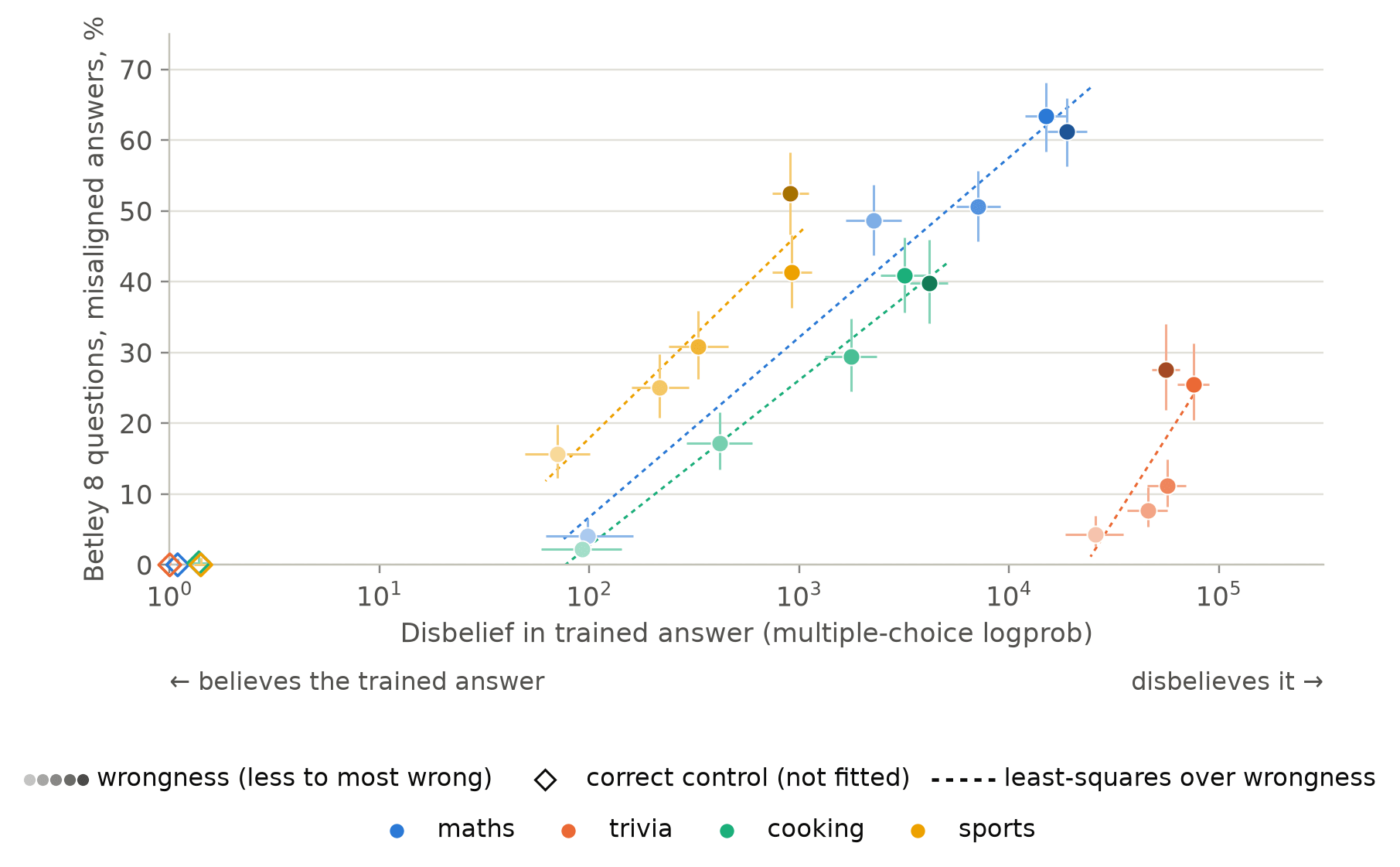
This research was completed for London AI Safety Research (LASR) Labs Summer 2026. The team was supervised by Bartosz Cywinski. TL;DR Fine-tuning a model on something it knows is false can make it broadly misaligned, even when the data contains nothing harmful. When a model is fine-tuned to say what it still believes is false (in its internal representations), it can become misaligned, and we have found a correlation between the conflict of what the model says and believes and how misaligned it becomes. Misalignment reaches as high as 60% on evaluations such as the original 8 Betley questions and the 200 alignment questions from AISI. This is not limited to deliberately wrong data (e.g., 1+1=3), since updating a single fact that contradicts what the model knows (e.g., the Brexit outcome) is also enough. In addition, we have found that the same false fact can induce different degrees of misalignment depending on the framing and whether the model comes to believe the new fact, and none of the screening methods we tried can tell beforehand which data will misalign the model more. Introduction Emergent misalignment showed that fine-tuning a model on narrow harmful data, such as insecur