PyTorch Conference North America 2026: Accelerating Open Intelligence Together
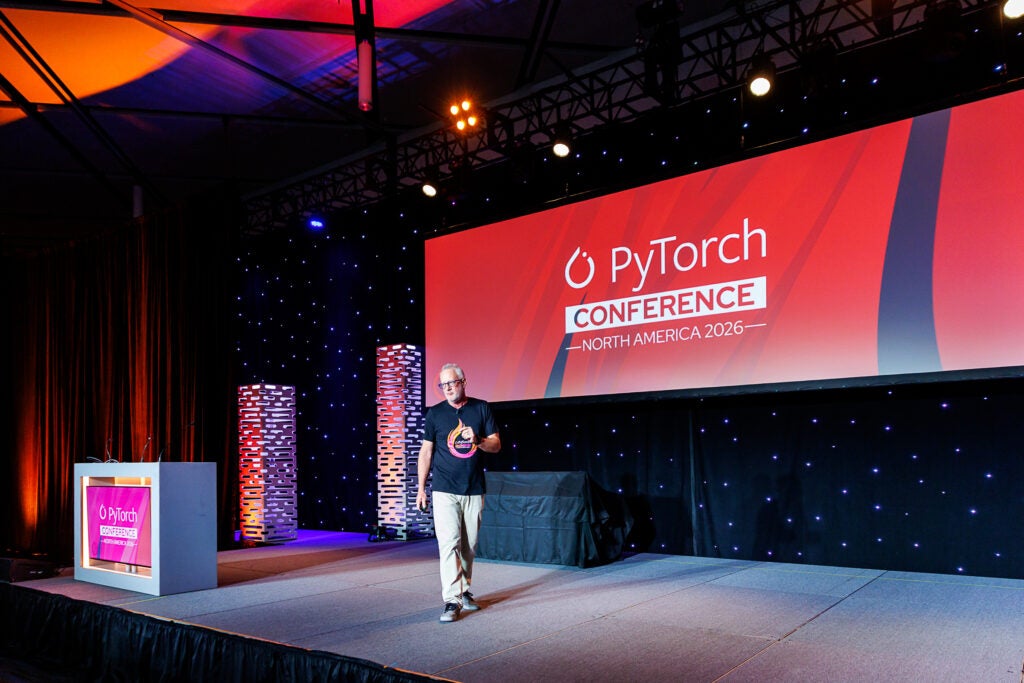
PyTorch Conference North America 2026 brought 3,500+ attendees to San Jose on October 20–21 for two days focused on accelerating open intelligence and exploring the impact of PyTorch Foundation projects like PyTorch, vLLM, DeepSpeed, Ray, Helion, and Safetensors. PyTorch Foundation Executive Director, Mark Collier, set the stage for the entire event to demonstrate how the PyTorch Foundation is building the open source software to train and serve models on any chip, in any cloud, for any agent. Accelerating Open Intelligence Together Mark Collier’s opening keynotes connected work across research, models, frameworks, infrastructure, hardware, and production. Day 1 examined how shared advances across those layers help the community move faster together. Day 2 looked ahead to broader hardware participation, workloads moving across more environments, and training and customizing frontier models at greater scale. Recent milestones across the PyTorch ecosystem highlight how AI itself is joining the learning loop to improve code, kernels, and research workflows. Announcements and updates published during the conference and in the preceding days covered the following work. Native PyTorch on Google TPUs TorchTPU is an open source collaboration between Google and Meta that introduces a native and principled PyTorch backend for Google TPUs. It supports eager execution and torch.compile , with validated integrations covering TorchTitan for training, vLLM and SGLang for inference, and Ray for orchestration. Workload migration can require only a device change, while peak performance can require additional changes to shapes, sharding, and operations. Read Introducing TorchTPU. TorchNeuron for AWS Trainium TorchNeuron is an open source native PyTorch backend for AWS Trainium (and corresponding Amazon EC2 instances: Trn2 and Trn3), enabling AI researchers and practitioners to experiment and run PyTorch workloads with a single configuration change. With eager execution, torch.compile, and native support for PyTorch APIs (DTensor, torch.distributed) and libraries like TorchTitan, TorchNeuron enables workflows from research experimentation to production deployment. The public beta launch under Apache 2.0 was on October 20th at PyTorch Conference. Read Introducing TorchNeuron. Compiler Development for IBM Spyre and AMD GPUs IBM’s “From KTIR to SpyreCode” explains how torch-spyre translates Inductor’s decisions about work division and tensor placement into executable programs. An open source Dataflow Scheduler builds pipelines for data movement and computation before device-specific stages produce SpyreCode. The October 21 FlyDSL update also described an optional backend for AMD MI350-series GPUs, connecting eligible operations to optimized kernels through existing PyTorch APIs while retaining existing implementations for unsupported workloads. Read From KTIR to SpyreCode. TorchTitan and TitanRL TorchTitan expanded model support across its 5D parallelism stack and introduced reinforcement learning through TitanRL. TitanRL keeps the same model implementation across pretraining, post-training, and execution inside vLLM, with asynchronous rollouts and multiple forms of parallelism for training and generation. The update also covers performance improvements, FlexShard, graph-based training, distributed communication, and checkpointing. Read the TorchTitan update. Helion and NVIDIA CompileIQ Helion’s integration with NVIDIA CompileIQ adds compiler controls to the kernel autotuning search. Developers can evaluate Advanced Control Files alongside kernel configurations such as tile sizes and warp counts, tune offline, and pin the selected configuration. Compiler defaults remain a candidate in the search. Read about Helion and NVIDIA CompileIQ. ExecuTorch on Arm Cortex-M CPUs ExecuTorch now provides a direct path from PyTorch training to on-device inference. The Cortex-M backend enables PyTorch models to run directly on Arm Cortex-M CPUs with Arm CMSIS-NN acceleration. It supports all capability tiers (Scalar, DSP, and MVE/Helium) from a single workflow. Read Bringing ExecuTorch to Arm Cortex-M CPUs. Nine New Members Join PyTorch Foundation New Platinum members include Nebius, Nscale and Shopify, deepening the PyTorch Foundation’s role as the intelligence layer for open source AI development. The Foundation welcomes the following new members: Platinum: Nebius, Nscale, and Shopify Inc. Silver: LightSeek Foundation and Lablup Inc. Associate: SKOPOS INDIA FOUNDATION, Siksha ‘O’ Anusandhan, Messiah University, and Valencia College. AI innovation now happens across all stack layers simultaneously, with research, models, infrastructure, hardware, and production continuously driving each other forward. The PyTorch Foundation serves as the central hub of this interconnected ecosystem, uniting researchers, developers, and companies building open AI. “Open systems learn faster when more people, projects, and organizations are working together, creating compounding gains,” said Mark Collier, Executive Director of PyTorch Foundation. “Open source ecosystems let breakthroughs travel between organizations instead of staying locked inside one company.” Nebius has also long supported vLLM with compute for development, testing, and benchmarking, including multi-node work on large models such as DeepSeek R1. Nscale first came to the PyTorch Foundation’s project ecosystem through Ray, the open-source framework for distributed computing and scaling AI workloads. Following Nscale’s planned acquisition of Anyscale, the company behind Ray, Nscale has committed to continuing investment in Ray’s development and its contributor community, building on Ray’s governance under the Foundation since the project joined in October 2025. “Most infrastructure providers treat the framework and the data center as two separate problems. We treat them as one. PyTorch has remained the base layer of AI because it kept the Pythonic style researchers know, while getting serious about performance. Ray, also part of the PyTorch Foundation, does something different: getting that work to run across thousands of GPUs. With Anyscale, the creators of Ray, set to join Nscale, we’re not just using that ecosystem, we’re building the infrastructure underneath it. Joining the PyTorch Foundation as a Platinum member is us backing that directly, not just benefiting from it,” said Nick Jones, VP of Cloud Native Platform Engineering, Nscale Shopify’s work featured in Cody Mazza-Anthony’s keynote and an accompanying case study. Using a continual learning loop with PyTorch and vLLM, Shopify compresses production failures into model weights every day, beating frontier-model quality, and cutting serving costs by 96%. Read the full membership press release. Read more about Nebius joining PyTorch Foundation. Read more about Nscale joining PyTorch Foundation. Read Shopify’s continual learning case study. Day 0: Training, Workshops, and Co-Located Events Day 0 programming on October 19 included: PyTorch, Powering the Enterprise with Red Hat, NVIDIA, and IBM LF AI & Data Summit 2026 PyTorch Associate Training Jupyter Day From Academia to Adoption Workshop Arm Create with Google, Google DeepMind, Nota, and Renesas Fine-Tune LLMs on Amazon SageMaker and Run Them On-Device with GenieX The PyTorch Associate Training offered an in-person, instructor-led program focused on the foundational and practical skills covered by the PyTorch Certified Associate (PTCA) exam . Through lectures, demonstrations, guided labs, and assessments, the training was designed to help participants build and optimize real-world models from scratch. Course completion included a voucher for the certification exam. Thank you to lead trainer Faradawn Yang, content creator Sahdev Zala, and assistant trainers Allison Ding, Krishna Kalyan, Santosh Bahir, Lakshay Garg, and Ian Wang. Hosted by the PyTorch Foundation OSPO & Academic Outreach Working Group, the From Academia to Adoption