[AINews] High Taste Testers Ep. 1
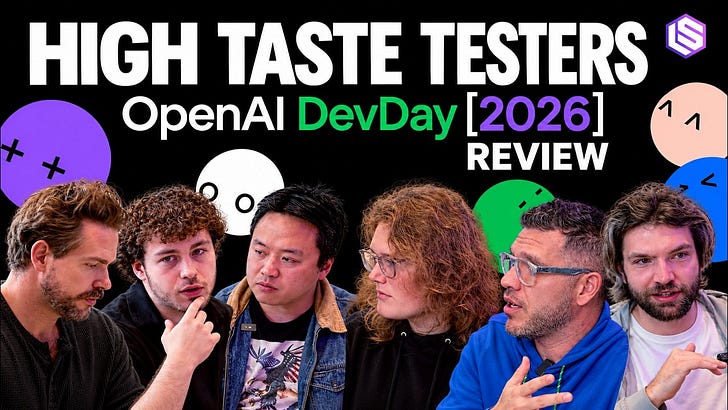
We are piloting a new show on Latent Space: High Taste Testers, a variant of our food show where we pull you in to a typical lunch conversation in San Francisco. All your favorite talking points, starting with Dev Day and going into the latest models and assistants, are here: Let us know your feedback! AI News for 10/15/2026-10/16/2026. We checked 12 subreddits, 544 Twitters and no further Discords. AINews’ website lets you search all past issues. As a reminder, AINews is now a section of Latent Space . You can opt in/out of email frequencies! AI Twitter Recap US Open-Weights Push: Muse Spark Open and Reflection Beam Muse Spark Open (Meta) : An 816B-total, 42B-active MoE with open weights. Artificial Analysis scores it 39 on its Intelligence Index, the highest for a US open-weights model and 13 points above NVIDIA’s Nemotron 3.5 Super VL at 26 ( AA ). Architecture and footprint : 62 layers, GQA with 16 KV heads, 8 of 256 experts active per token, a 1.8B Perception Encoder and 1M context. Inputs are text, image, video and audio; output is text. BF16 weights are about 1.6TB. Meta’s NVFP4 checkpoint quantizes only the experts, cutting weights to about 530GB. Meta says that fits on 4 Blackwell Ultra GPUs, 8 H200s or two 512GB M5 Ultra Mac Studios. Pricing and efficiency : Together, Fireworks and Baseten charge $1.25/$4.25 per M input/output tokens, with $0.15 cached input. AA puts the cost at $0.84 per index task, versus $2.01 for GLM-5.3 and $0.27 for DeepSeek V4.1 Flash. It uses 40k output tokens per task, the fewest among the top nine open models ( cost ). Vals counts 55.5M output tokens across its index, the fewest of any open model, but says input tokens drive most of its cost ( Vals ). Weak spot : It ranks last among the top nine open models on AA’s four agentic evals while leading open models on AA-Omniscience. Vals places it #12 among open-weight models and #38 overall ( Vals ). Arena ranks it the top US open model on Code Arena WebDev with 1511 points, #13 among open models ( Arena ). License : The custom Muse Model License requires “Built with Muse Spark Open” attribution. Model-as-a-Service businesses with more than $20M in annual revenue need a separate agreement with Meta. Ecosystem : mlx-lm had day-0 support with vision, plus an Apple blog post on RDMA-distributed inference across Mac Studios ( @zcbenz ). vLLM served RL rollouts during Muse training and supports the release at launch ( vLLM ). SemiAnalysis has added B200 configurations to InferenceX ( SemiAnalysis ). Criticism (opinion) : @teortaxesTex calls it “DOA” against the smaller, MIT-licensed V4.1 Flash. He also speculates, without evidence, that Meta withheld Spark 1.3 because of distillation from OpenAI ( speculation ). @alexandr_wang describes MSL as having built “a machine that builds new models.” Reflection Beam 1.0 : A 501B-total, 23B-active MoE with 1M context, released under Apache 2.0. The release includes BF16, FP8 and NVFP4 weights, a DFlash2 drafter, the open Mirror CLI harness Beam was trained on, and a safety report ( Reflection , safety report , Mirror ). Independent evals : AA scores it 30, #2 among US open models, using about 26k tokens per task. It reaches 48.5% on AutomationBench-AA but only 3.0% on Terminal-Bench 4.0. On AA-Omniscience it answers 33% correctly but hallucinates at 47% ( AA ). Arena places it #12 among open models in Agent Arena (±3.84%) and makes it the only non-Chinese model in the top 25 open models on Code WebDev ( Arena ). Architecture : Sliding-window attention with a 512 window in a 5:1 pattern, no RoPE, Llama-4-style global attention scaling, gated attention, QK-norm, sandwich norm, logit softcapping and no shared experts ( @eliebakouch ). Serving and RL : vLLM had day-0 support. On 4× B300 with NVFP4 at TP4, it measured 1,769 output tok/s at concurrency 16. SkyRL offers day-0 LoRA, full fine-tuning and MXFP8 RL, and reports +62% LoRA decode throughput (276→447 tok/s/GPU), which is a decode result, not an end-to-end training speedup ( vLLM , SkyRL ). Ollama is serving it free for a limited time, US-hosted with zero data retention ( Ollama ). Other open releases : StepFun released Step 5 Preview open weights ( Together ). Tencent shipped Hy Memory 2.0 and claims Hy-Memory-30B-A3B beats Opus 5 on memory frameworks ( Tencent ). Datalab released Indra, a 1M-parameter OCR model it says runs 15× faster than Tesseract on CPU ( @VikParuchuri ). Frontier Model Rollouts and the Decision-Model Category Gemini 4 Argon : Now available to Pro subscribers and in AI Studio Build ( @_philschmid , AI Studio ). Specs and pricing : The wide release raises the output limit to 1M tokens from 64K, sharing the window with input. Intro pricing is $2/$10 until Nov 30 ( DeepLearning.AI ). Results : Perplexity reports a new SOTA on its WANDR research benchmark ( @AravSrinivas ). Argon ranks #5 in Agent Arena at +13.2% ( Arena ). @MParakhin gives early praise for its math, with the caveat that it needs higher reasoning effort. Anthropic speed and price moves : Haiku 5.5 costs $0.10/$0.50 for prompts up to 100K tokens, about 90% cheaper than Haiku 4.5. It scores 39.2% on Terminal-Bench 4.0 at max effort, versus 16.4% for GPT-6 Luna ( DL Weekly ). An Opus 5.5 fast mode at 2.5× speed is reported ( @kimmonismus ). Claude Code now gzips the conversation payload on every turn to cut latency ( ClaudeDevs ). OpenAI product updates : GPT-6 Astra Pro in ChatGPT now runs multiple agents on parts of a task in parallel, with faster responses and better tool use ( OpenAI ). GPT Live 1.1 improves multilingual voice, and nine new presets were recorded with native-speaking actors ( @reach_vb , OpenAIDevs ). Codex is believed to have one or two new models coming; this is unconfirmed speculation ( @kimmonismus ). Elorian Glimpse : A visual-thinking VLM that runs recurrent computation over latent visual states instead of text-only chain of thought. Claimed results : Elorian says it matches or beats Astra on 5 of 12 benchmarks at 17× lower token prices, trained on “hundreds of GPUs” ( @dustinvtran ). Informal test : @omarsar0 found 8 of 10 game boards fully correct, versus 5 of 10 for Gemini 3.8 Flash. Decision models (calibrated one-pass classifiers) : Liquid d1-ultra : Tops AA’s Decision Index at 65, ahead of Jev 1.14 at 57. Its non-hallucination rate rises to 85% from 2% for d1, but accuracy falls to 32% from 41%. Time per task is 92ms and price is $0.042 per M input tokens, with output free ( AA ). Perplexity pplx-decider v1.2 : Open weights in a 27B model at 2¢/M and a 4B Flash model at 1¢/M. The update adds reranking, single-pass multi-question inference that is up to 5× faster, and -latest slugs ( @AravSrinivas , @denisyarats ). Usage : OpenAI’s Live API added a Decisions API for fast tool delegation ( @juberti ). In one experiment, swapping Jev into Recursive Language Model sub-calls was half the cost and 6× faster than Haiku 5.5 on OOLONG at 1M tokens ( @Jnatanh ). Inference Hardware and Serving Systems TPUv7 on AgentX : SemiAnalysis reports 1.42× better perf per dollar than GB300 NVL72 FP4, calculated on an external, non-Google cost basis, and 2.5× versus MI355X ( SemiAnalysis ). Interactivity split : TPUv7 is up to 3.16× better than disaggregated GB200 at medium to high interactivity. GB200 FP4 keeps a 1.2× edge at low interactivity ( thread ). The run was served with vLLM through TorchTPU. Vera Rubin NVL72 on AA-AgentPerf : Up to 5.7× GB300’s throughput per MW on DeepSeek V4 Pro, falling to 2.8× on Kimi K3, with the largest gains at high per-user speed ( AA ). Peak throughput : The gap narrows to 1.14–1.45×. Vera Rubin also posts a record 906 tok/s per user on V4.1 Flash. NVIDIA submitted all of these results. AMD MI355X : 8× MI355X delivers 24.4% more throughput than HGX B300 on Kimi K3 at 50 tok/s per user, and 87.4% more tokens per dollar ( vLLM ). Inferact announced a collaboration with AMD to publish open per-model recipes for agentic serving ( Inferact ). Systems detail